· Marcus Lin · Engineering · 9 min read
China PCB Manufacturing Pricing 2026
Transparent pricing breakdown for sourcing PCBs from China in 2026. Covers actual cost ranges for standard FR-4, controlled impedance, HDI, Rogers/RF, and rigid-flex boards — with specific price multipliers for each complexity factor and optimization strategies that reduce your quote by 20-40%.
Quick Answer
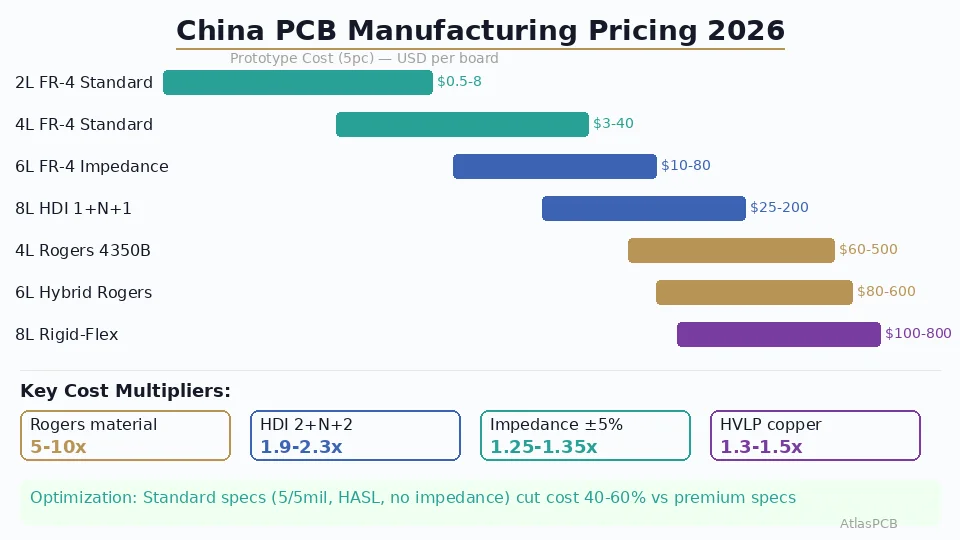
China PCB pricing in 2026 ranges from $0.50/board for standard 2-layer prototypes to $800+/board for complex RF or HDI designs. The primary cost multipliers are: layer count (each added pair adds 25-40%), material type (Rogers adds 5-10x vs FR-4), HDI buildup (each sequential lamination cycle adds 35-50%), controlled impedance (15-30% premium), and backdrilling (10-20% per drill cycle). Understanding these multipliers lets engineers optimize designs to hit the right price/performance balance before requesting quotes.
2026 China PCB Pricing Overview
| Board Type | Prototype (5pc) | Low Volume (50pc) | Production (500pc) | Production (5000pc) |
|---|---|---|---|---|
| 2-layer FR-4, standard | $2-8 | $0.80-2 | $0.40-1 | $0.20-0.50 |
| 4-layer FR-4, standard | $8-40 | $3-8 | $1.50-4 | $0.80-2.50 |
| 6-layer FR-4, impedance | $30-80 | $10-25 | $4-10 | $2-5 |
| 8-layer FR-4, HDI 1+N+1 | $80-200 | $25-60 | $8-18 | $4-9 |
| 10-layer FR-4, HDI 2+N+2 | $150-400 | $50-120 | $15-35 | $8-18 |
| 4-layer Rogers 4350B | $150-500 | $60-150 | $30-80 | $15-40 |
| 6-layer hybrid Rogers/FR-4 | $200-600 | $80-200 | $40-100 | $20-50 |
| 8-layer rigid-flex | $300-800 | $100-300 | $50-150 | $25-75 |
Note: Prices are per-board for typical 100x100mm dimensions. Larger boards, tighter tolerances, and premium finishes adjust pricing upward from these baselines.
What Drives PCB Cost: The Multiplier Framework
Understanding PCB pricing requires thinking in multipliers rather than absolute numbers. Every specification choice multiplies your base board cost. The key insight for cost optimization: a single premium specification forces the entire board into a higher manufacturing tier, even if only one net needs that capability.
The base cost of a PCB comes from four fixed elements: panel material cost, imaging and etching (per layer pair), drilling (per hole count), and finishing. Every additional specification requirement adds a multiplier:
| Cost Factor | Standard (1.0x) | Mid-Tier (multiplier) | Premium (multiplier) |
|---|---|---|---|
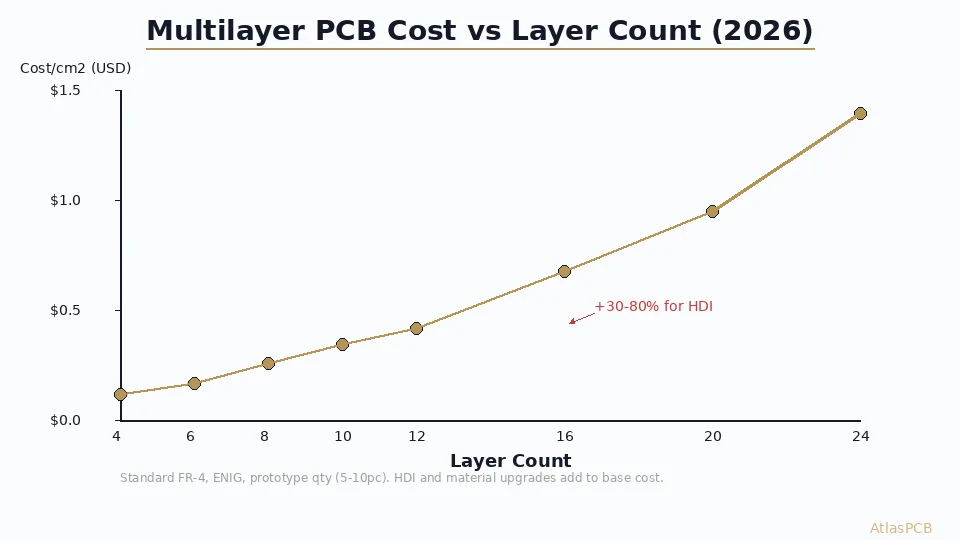
| Layer count | 2L (1.0x) | 4L (2.2-2.5x), 6L (3.0-3.5x) | 8L (4.0-4.5x), 10L+ (5.5-7x) |
| Material | FR-4 Tg140 (1.0x) | High-Tg FR-4 (1.1-1.3x) | Rogers (5-10x), Polyimide (3-5x) |
| Trace/space | 5/5mil (1.0x) | 4/4mil (1.2x) | 3/3mil (1.5-2.0x) |
| Drill size | 0.3mm+ (1.0x) | 0.2mm (1.1x) | 0.15mm (1.3x), laser 0.1mm (HDI) |
| Impedance | None (1.0x) | ±10% (1.15-1.2x) | ±5% with TDR (1.25-1.35x) |
| Surface finish | HASL (1.0x) | ENIG (1.15x) | Hard gold (1.5-2.0x) |
| Copper weight | 1oz (1.0x) | 2oz (1.1x) | 3oz+ (1.3-1.5x) |
| HDI buildup | None (1.0x) | 1+N+1 (1.35-1.5x) | 2+N+2 (1.8-2.2x), 3+N+3 (2.5-3.5x) |
| Backdrilling | None (1.0x) | Single pass (1.1-1.2x) | Multi-pass (1.2-1.35x) |
These multipliers compound. An 8-layer HDI board with Rogers, ±5% impedance, and ENIG finish multiplies the base cost by roughly 4.5 x 5 x 1.3 x 1.15 = 33.6x compared to a basic 2-layer FR-4. This compounding is why complex boards jump from $2 to $400+ — every specification decision matters.
TRANSPARENT PRICING
Know Exactly What Drives Your PCB Cost
Upload your Gerber and get itemized pricing showing each cost driver. No hidden fees, no surprise markups on materials or testing.
Get Itemized Quote ›
RF PCB Pricing Deep-Dive: Why Rogers Boards Cost What They Do
The cost premium for RF PCBs on Rogers material breaks down into three distinct components, and understanding each reveals optimization opportunities. Material cost accounts for approximately 40-50% of the premium, processing for 25-35%, and testing/yield loss for 15-25%.
Material cost is straightforward: Rogers RO4350B at 10mil thickness costs approximately $280-350 per 18x24” panel versus $15-25 for equivalent FR-4. This 12-15x material premium directly translates to board cost. However, the material cost per board depends heavily on panel utilization — a 50x50mm RF module uses only 8% of the panel area, meaning material cost per board is manageable. A 200x300mm radar board consuming half the panel feels the full material premium.
Processing cost adds premium for several reasons. First, Rogers material requires careful parameter control during lamination of hybrid stackups — temperature ramp rates and pressure must be precisely controlled to prevent delamination at the Rogers/FR-4 interface. Second, drill parameters differ slightly (slower feed rate to prevent delamination at material transitions). Third, etching Rogers-bonded copper requires adjusted chemistry timing. These process adjustments reduce throughput by 15-25% compared to pure FR-4 production.
Testing cost is the often-overlooked component. Every production panel of a controlled-impedance RF board requires TDR measurement of test coupons, adding 5-10 minutes of technician time per panel. At yields of 85-92% on complex RF boards (versus 95%+ for standard FR-4), the cost of scrapped panels — containing $300+ of Rogers material — distributes across the passing boards. A 90% yield means 10% of material and processing cost must be recovered from the 90% of panels that pass.
From our production data, here is what specific RF board configurations actually cost in 2026:
| RF Board Configuration | Material | Prototype (5pc) | Production (100pc) |
|---|---|---|---|
| 2-layer Rogers 4350B, 20mil | RO4350B | $80-150 | $25-45 |
| 4-layer hybrid (2 Rogers + 2 FR-4) | RO4350B+FR-4 | $200-400 | $50-100 |
| 4-layer all-Rogers | RO4350B | $350-600 | $80-180 |
| 6-layer hybrid (2 Rogers + 4 FR-4) | RO4350B+FR-4 | $300-500 | $60-130 |
| 4-layer PTFE (RT/duroid) | PTFE | $500-900 | $120-250 |
HDI PCB Cost Structure: Sequential Lamination Economics
HDI boards cost more than standard multilayer because each sequential lamination cycle adds a complete fabrication pass — drilling, plating, imaging, etching — to layers that have already been partially built. Every additional HDI cycle compounds processing cost and reduces yield because more things can go wrong on a partially-completed board.
The economics of HDI buildup options from our facility:
A standard 8-layer through-hole board requires one lamination cycle (all layers pressed simultaneously), one drill cycle, and standard plating. Total processing steps: approximately 35. The same routing density achieved through 1+N+1 HDI (6-layer core + 1 buildup each side) requires: core fabrication (inner layers), first lamination, laser drilling of microvias, microvia plating, outer layer imaging and etch, second lamination with cap layers… approximately 55 processing steps. The 2+N+2 equivalent pushes to 75+ steps.
Each processing step has associated cost (equipment time, materials, labor) and yield risk. If each step has 99.5% yield, the cumulative yield for 35 steps is 84% versus 76% for 55 steps and 69% for 75 steps. Lower cumulative yield means more panel scrap, and that scrap is expensive because it has already consumed 50-75% of the total processing before the defect occurs.
The practical pricing impact at our production volumes:
| HDI Type | Layers | vs Standard Multilayer Cost | Typical Yield |
|---|---|---|---|
| Standard 8L | 8 | Baseline (1.0x) | 93-96% |
| 1+N+1 (8L total) | 8 | 1.4-1.6x | 88-92% |
| 2+N+2 (8L total) | 8 | 1.9-2.3x | 83-88% |
| 2+N+2 (10L total) | 10 | 2.4-2.8x | 80-85% |
| 3+N+3 (12L total) | 12 | 3.2-4.0x | 75-82% |
The decision between HDI and additional standard layers is not always obvious. Sometimes adding 2 standard layers (going from 8L to 10L through-hole) is cheaper than staying at 8L with 1+N+1 HDI — it depends on your specific routing density and BGA pitch requirements. We analyze this tradeoff during DFM review and recommend the most cost-effective construction that meets your density requirements.
COST OPTIMIZATION
Get the Lowest-Cost Construction for Your Routing Density
Our engineers compare standard multilayer vs HDI vs hybrid approaches and recommend the most cost-effective solution that meets your design requirements.
Compare Pricing Options ›Rigid-Flex Pricing: Why It Costs 3-8x Standard Boards
Rigid-flex PCBs command the highest per-board premium in standard PCB manufacturing for several structural reasons. The material is inherently expensive (polyimide flex layers cost 3-5x FR-4), the process is complex (multiple lamination steps with selective bonding), and yield is lower (flex handling introduces defects that rigid boards never encounter).
The pricing breakdown for a typical 8-layer rigid-flex (4 rigid + 2 flex + 2 rigid):
| Cost Component | % of Total | Why It Costs This |
|---|---|---|
| Flex material (polyimide) | 25-30% | 3-5x FR-4 per area; coverlay adds additional layer cost |
| Selective lamination | 20-25% | Multiple press cycles, custom tooling for each design |
| Flex handling/inspection | 15-20% | Manual handling, 100% visual inspection of bend zones |
| Stiffener application | 10-15% | Die-cut stiffeners, adhesive bonding, alignment |
| Yield loss | 10-15% | 75-85% yield vs 95%+ standard; flex layer damage |
| Testing (continuity + flex) | 5-10% | Bend testing on samples, flex circuit continuity |
The volume effect on rigid-flex pricing is more dramatic than standard boards because NRE is higher (custom lamination tooling, flex routing fixtures) and material MOQ effects are stronger (polyimide film comes in fewer thickness options with higher minimums). At 5 pieces, rigid-flex NRE per board can be $50-100. At 500 pieces, it drops to $1-2 per board.
Cost Optimization Strategies That Actually Work
Based on our experience quoting and producing thousands of designs annually, here are the optimization strategies that deliver the largest cost reduction with least impact on functionality:
Move to standard trace/space whenever possible. The difference between 4/4mil and 5/5mil trace/space is often 15-20% in board cost. Many designs that route at 4/4mil can be relaxed to 5/5mil on non-critical nets with minimal board area increase. The routing density difference is typically only 10-15%, but the cost saving is immediate because 5/5mil keeps you in standard manufacturing processes.
Choose ENIG only where needed. ENIG adds 12-18% to board cost and is necessary only for fine-pitch BGA pads, wire bonding areas, and long shelf-life requirements. If your board has no BGA below 0.8mm pitch and ships within 6 months, OSP or immersion silver delivers equivalent solderability at lower cost. For selective requirements, specify ENIG pads with OSP field — some manufacturers support this mixed-finish approach.
Optimize panel utilization. A 45x95mm board on an 18x24” panel gives 8 boards per panel. Adjusting to 44x92mm might fit 10 per panel — a 25% per-board cost reduction from a dimension change invisible to your enclosure design. Ask your fabricator for their recommended board outline for optimal panelization before finalizing your mechanical drawing.
Consolidate drill sizes. Every unique drill size adds tool change time and registration complexity. Reducing from 15 unique hole sizes to 8 (by consolidating similar sizes to the next standard drill) can reduce drilling cost by 10-15%. Most via holes can use a single 0.3mm drill without affecting your routing capability.
Standard stackup materials. Specifying a material by brand name (e.g., “Isola 370HR only”) limits your manufacturer to a single supplier and eliminates competitive material sourcing. Instead, specify performance requirements (Dk 4.2-4.5, Df < 0.010, Tg > 170°C) and let your fabricator use their best-priced equivalent material. This alone can reduce material cost by 10-20% on high-Tg boards.
ATLASPCB
Get Your PCB Quote in 24 Hours — Itemized and Transparent
Upload Gerber files and receive detailed pricing showing exactly what each specification costs. Our engineers include cost optimization recommendations with every quote.
Get Instant Quote ›
Reviewed by AtlasPCB Engineering Team — 15+ years in advanced PCB fabrication for RF, HDI, and rigid-flex applications.
Related Reading:
About AtlasPCB — We specialize in complex PCB manufacturing for HDI, RF, and high-reliability applications. Explore our HDI PCB manufacturing capabilities, RF and high-frequency PCB services, or get an rigid-flex PCB manufacturing . Every order includes free engineering review. Get your quote.
Reviewed by AtlasPCB Engineering Team — IPC-certified manufacturing specialists with 15+ years of production experience in HDI, RF, and high-reliability PCB fabrication. Content based on factory floor data and real customer design reviews.
Frequently Asked Questions
How much does a standard 4-layer PCB cost from China in 2026?
Why do China RF PCB prices vary so much between manufacturers?
What is the cost difference between HDI and standard PCB manufacturing in China?
How much does controlled impedance add to PCB cost in China?
What volume breakpoints reduce PCB cost from China manufacturers?
- China RF PCB manufacturer
- HDI PCB manufacturer
- rigid-flex PCB manufacturer
- impedance controlled PCB manufacturer
- multilayer PCB cost