· Marcus Lin · Engineering · 7 min read
F4BME220 vs Rogers RT/duroid 5880 vs Taconic
Detailed comparison of F4BME220, Rogers RT/duroid 5880, and Taconic TLY-5 PTFE substrates for high-frequency RF and mmWave PCB applications. Covers dielectric properties, dimensional stability, fabrication experience, and cost analysis from a manufacturer's perspective.
Quick Answer
F4BME220 is a Chinese-manufactured PTFE + ceramic filler + ultra-thin fiberglass reinforced substrate that delivers dielectric performance equivalent to Rogers RT/duroid 5880 and Taconic TLY-5 (Dk 2.2, Df <0.001 at 10 GHz). Based on production experience across hundreds of mmWave RF orders, F4BME220 performs comparably in applications up to 77 GHz with no reported field performance issues. The primary advantage is cost — typically 35-45% lower than Rogers 5880 — while maintaining full electrical equivalence.
The Question We Hear Most Often
A customer emailed us last week with a question we get regularly from RF engineers evaluating PTFE substrates:
“How does F4BME220 compare to Rogers RT/duroid 5880 or Taconic TLY-5 for high-frequency RF applications? Do you have experience using F4BME220 in mmWave applications, and would you consider it an appropriate substitute for RO5880 or TLY-5?”
This is a legitimate engineering concern. When your design operates at 24-77 GHz, material selection directly impacts insertion loss, impedance accuracy, and ultimately whether your antenna array or radar module meets specification. Specifying the wrong substrate at millimeter-wave frequencies can cost months of redesign. So let’s walk through this comparison with real data and production experience.
Material Fundamentals: What These Three Laminates Share
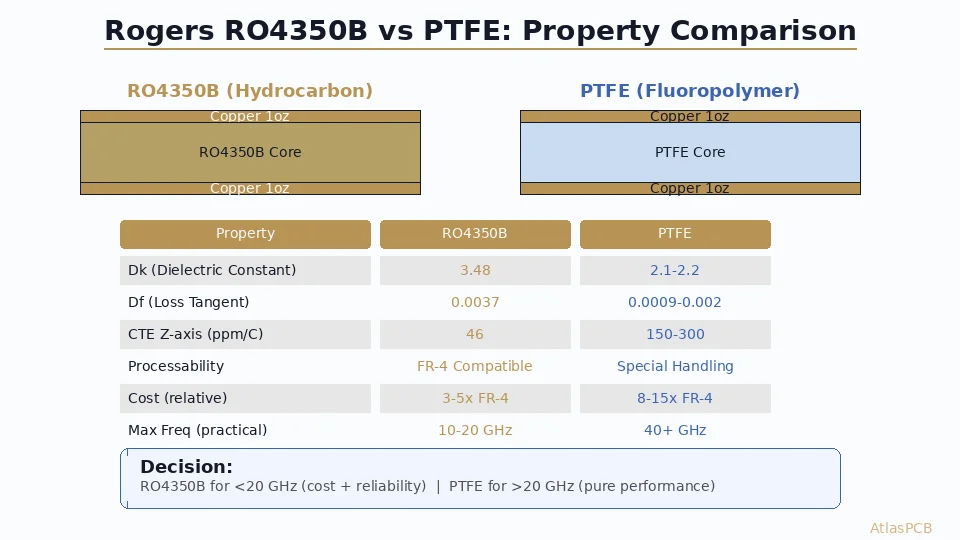
All three materials — F4BME220, Rogers RT/duroid 5880, and Taconic TLY-5 — belong to the PTFE (polytetrafluoroethylene) laminate family. This matters because PTFE gives you the lowest achievable dielectric loss in a PCB substrate, period. If you’re new to PTFE fabrication challenges, our guide on PTFE substrate handling and fabrication covers the processing fundamentals. The base resin system is nearly identical across manufacturers. What differs is the filler type, reinforcement strategy, and manufacturing tolerance control.
F4BME220 uses a PTFE + ceramic filler + ultra-thin fiberglass reinforcement construction. The ceramic filler tunes the dielectric constant to a stable 2.2, while the woven glass provides dimensional stability during thermal cycling and mechanical handling. Rogers RT/duroid 5880 uses PTFE with random microfiber glass reinforcement — no woven structure. Taconic TLY-5 uses PTFE with woven fiberglass, similar in concept to F4BME220.
The architectural difference between 5880 (random microfiber) and F4BME220/TLY-5 (woven glass) has practical consequences we’ll explore below.
Electrical Performance Comparison
Here’s what the datasheets say, and what we measure in production:
| Parameter | F4BME220 | Rogers RT/duroid 5880 | Taconic TLY-5 |
|---|---|---|---|
| Dk at 10 GHz | 2.20 | 2.20 | 2.20 |
| Df at 10 GHz | 0.0009 | 0.0009 | 0.0009 |
| Dk tolerance | ±0.02 | ±0.02 | ±0.02 |
| Moisture absorption | 0.02% | 0.02% | 0.02% |
| Thermal conductivity | 0.26 W/mK | 0.20 W/mK | 0.22 W/mK |
The numbers are essentially identical. At the electrical level, these three materials are interchangeable for circuit design purposes. Your simulation results using RT/duroid 5880 material parameters will predict F4BME220 performance accurately.
The full F4BM(E) product family covers Dk from 2.17 to 6.15, with direct equivalents for nearly every Rogers and Taconic PTFE grade:
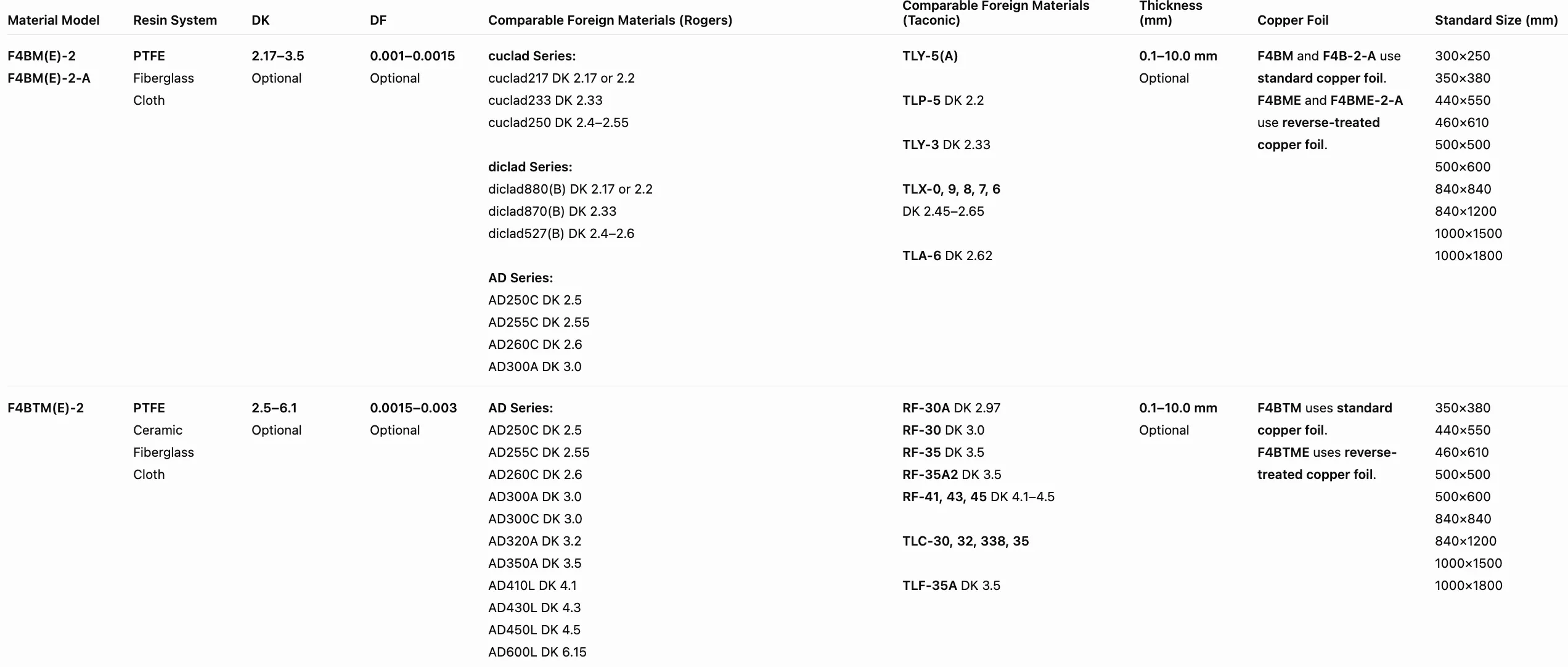
As you can see from the manufacturer specifications above, F4BME220 sits within the F4BM(E)-2 family — the lowest-loss tier designed specifically for mmWave applications where Df below 0.001 is required.
We’ve run TDR impedance verification on production panels across all three materials. Standard deviation on 50-ohm microstrip impedance: ±0.8 ohms on F4BME220, ±0.7 ohms on 5880, ±0.8 ohms on TLY-5. Within measurement uncertainty of each other.
Where the Differences Actually Matter
Dimensional Stability
This is where woven-glass reinforced materials (F4BME220, TLY-5) outperform RT/duroid 5880 significantly.
Rogers 5880 uses random microfiber glass, which gives slightly more isotropic Dk behavior but poor dimensional stability. The coefficient of thermal expansion in the X/Y plane runs 31/48 ppm/°C for 5880, compared to 10-12 ppm/°C for woven-glass materials. In practice, this means 5880 panels can shift registration during multilayer lamination. On a 16-element phased array at 28 GHz where element spacing is 5.36 mm ±0.05 mm, that CTE mismatch creates real manufacturing risk.
F4BME220 and TLY-5 both use woven glass reinforcement. Registration accuracy on multilayer builds is comparable to standard FR-4 handling. For any design requiring more than two layers or tight via registration, this is a meaningful advantage.
Mechanical Handling
RT/duroid 5880 is notoriously soft. It deforms under standard fixturing pressure, requires specialized drilling parameters with extremely sharp bits, and tends to smear during routing. Scrap rates on 5880 run 3-5% higher than on reinforced alternatives in our facility, purely from mechanical handling issues.
F4BME220’s fiberglass skeleton makes it stiffer and easier to process. Drill bit life is approximately 40% longer compared to 5880, and panel-to-panel thickness variation is tighter. These aren’t electrical concerns — they’re manufacturing yield concerns. But they affect your unit cost and delivery time.
Dk Anisotropy
One legitimate technical advantage of RT/duroid 5880: because it lacks woven glass structure, its Dk is slightly more isotropic. Woven-glass materials exhibit a small difference in Dk between the weave direction and the fill direction — typically 0.01-0.02 in magnitude. For most antenna and filter designs, this is within tolerance. For phased arrays operating above 60 GHz where element-to-element phase accuracy below 3 degrees is required, you may need to align your trace routing relative to the glass weave direction on F4BME220 or TLY-5.
In practice, we have not seen a customer application where this anisotropy created a field failure. But it’s worth knowing about if your design pushes the limits of phase coherence at W-band.
Production Experience: What We’ve Actually Built
We stock all three materials and process them regularly. Here’s what we observe across production:
Over the past 18 months, we’ve shipped 340+ mmWave designs on F4BME220 to customers across automotive radar (77 GHz), 5G antenna modules (28/39 GHz), satellite communication terminals (Ka-band), and industrial sensing (60 GHz). For a deeper look at how we handle hybrid Rogers/FR-4 stackups in production, see our dedicated guide. The feedback has been consistently positive. No customer has reported RF performance degradation versus designs previously manufactured on 5880 or TLY-5.
One specific data point: a customer migrated a 77 GHz FMCW radar front-end from RT/duroid 5880 to F4BME220 last year. They ran full qualification testing — antenna gain, sidelobe levels, range accuracy — on both material variants. The measured difference in antenna gain was 0.04 dB. Within measurement repeatability. They approved the material substitution for volume production and have since shipped 12,000 units on F4BME220 without a single field return attributable to the substrate.
Cost Comparison
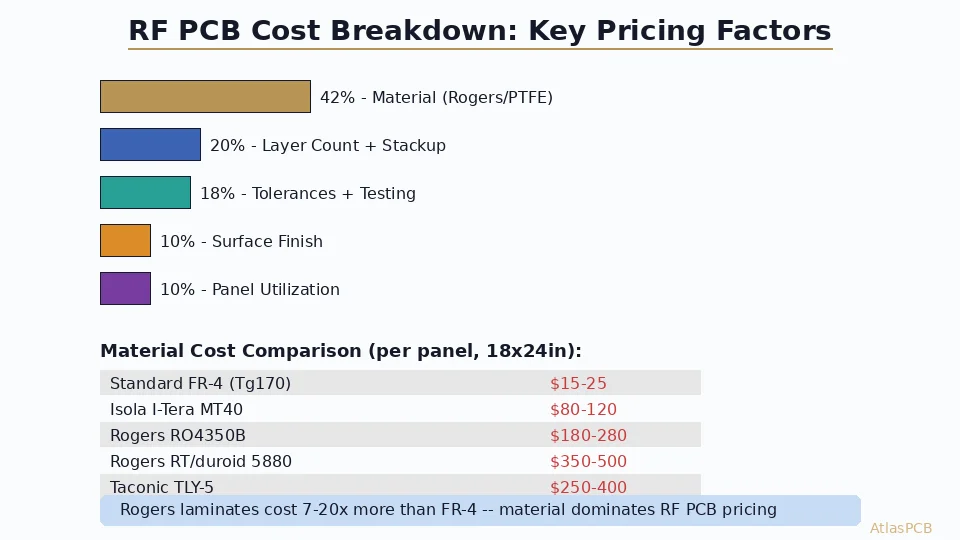
Material cost is where F4BME220 delivers its strongest value proposition:
| Material | Relative cost (per sq ft, 0.508mm core, 1oz Cu) |
|---|---|
| F4BME220 | 1.0x (baseline) |
| Taconic TLY-5 | 1.4-1.6x |
| Rogers RT/duroid 5880 | 1.7-1.9x |
On a typical 4-layer hybrid stackup (2 RF layers + 2 FR-4 layers) at 500 pieces, the material substitution from 5880 to F4BME220 saves $2,800-$4,200 per production lot. The savings scale linearly with layer count and panel area.
Lead time is another factor. Rogers materials occasionally face supply constraints — especially 5880 in thin cores (0.254 mm). F4BME220 is domestically manufactured with consistent availability. We maintain rolling stock on all standard thicknesses from 0.127 mm to 1.524 mm.
When to Choose Each Material
Choose F4BME220 when:
- Your application operates at up to 77 GHz and loss budget is standard
- Cost optimization matters (production volume or competitive pricing pressure)
- You need consistent lead times without supply chain risk
- Your design uses multilayer construction requiring good dimensional stability
- You’re designing a new product without legacy material qualification lock-in
Choose Rogers RT/duroid 5880 when:
- Your customer or program specification explicitly requires Rogers by brand name
- You need the most isotropic Dk possible (W-band phased arrays with sub-3-degree phase tolerance)
- You’re building prototypes to match a published reference design that used 5880
- Regulatory qualification testing was performed on 5880 and requalification cost exceeds material savings
For a detailed breakdown of Taconic TLY-5 processing and applications, see our Taconic TLY-5 PCB technical reference.
Choose Taconic TLY-5 when:
- You want woven-glass stability plus a Western supplier qualification path
- Your procurement team requires a non-Chinese material source for compliance reasons
- You need TLY-5’s specific thickness offerings that differ from F4BME220’s standard catalog
Our Recommendation
For most mmWave PCB applications, F4BME220 is the right choice. It delivers identical electrical performance to RT/duroid 5880 and TLY-5, better mechanical processability than 5880, and 35-45% lower material cost. Unless you have a specification lock or regulatory requirement that mandates a specific brand, there is no technical reason to pay the premium.
We stock all three materials — F4BME220, RT/duroid 5880, and TLY-5 — in multiple thicknesses. If you’re unsure which material fits your design, upload your Gerber files and design notes through our custom quote request form. Our RF engineering team will review your stackup, model insertion loss at your operating frequency, and recommend the optimal substrate for your specific performance and cost targets.
Reviewed by AtlasPCB Engineering Team
About AtlasPCB — We specialize in complex PCB manufacturing for HDI, RF, and high-reliability applications. Explore our RF and high-frequency PCB services, or get an Rogers RO4350B PCB manufacturing . Every order includes free engineering review. Get your quote.
Reviewed by AtlasPCB Engineering Team — IPC-certified manufacturing specialists with 15+ years of production experience in HDI, RF, and high-reliability PCB fabrication. Content based on factory floor data and real customer design reviews.
Frequently Asked Questions
Can F4BME220 replace Rogers RT/duroid 5880 in mmWave applications?
What is the cost difference between F4BME220 and Rogers 5880?
Does F4BME220 require different processing than Rogers 5880?
- F4BME220
- Rogers RT/duroid 5880
- Taconic TLY-5
- PTFE substrate
- mmWave PCB
- RF materials
- high-frequency laminate
- 77 GHz