· AtlasPCB Engineering · News · 7 min read
North American PCB Book-to-Bill Hits 1.60 in May 2026: AI Infrastructure Drives 102.8% Order Surge
The Global Electronics Association reports North American PCB bookings surged 102.8% year-over-year in May 2026, pushing the book-to-bill ratio to 1.60 — a historic level driven primarily by AI server and data center infrastructure buildout. What this means for PCB supply chains, lead times, and material availability.
Quick Answer
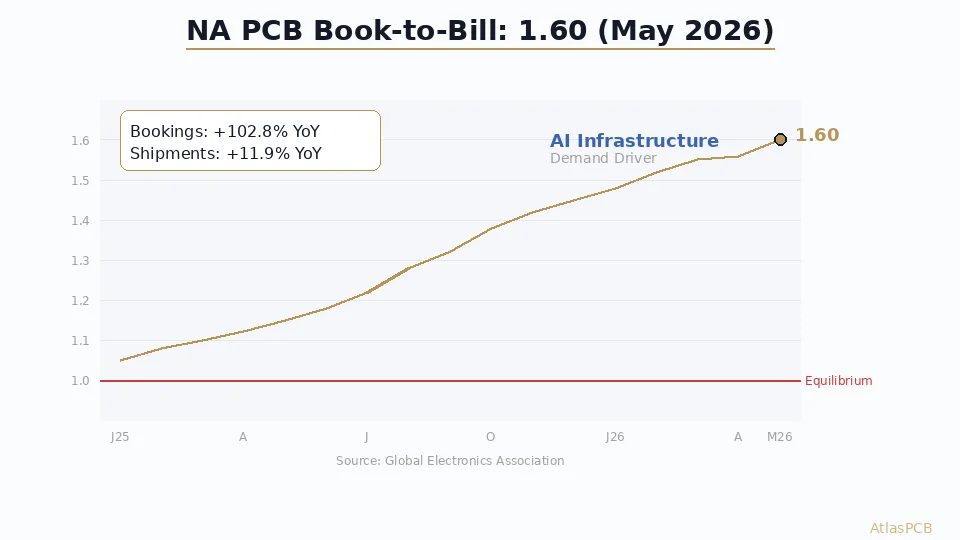
North American PCB bookings surged 102.8% year-over-year in May 2026, with the book-to-bill ratio reaching 1.60 according to Global Electronics Association data. Shipments grew 11.9% YoY while year-to-date bookings run 28.6% ahead of 2025. AI server and data center infrastructure spending is the primary demand driver, creating capacity constraints at high-complexity manufacturers.
Key Numbers: May 2026 North American PCB Market
| Metric | May 2026 | vs May 2025 | vs April 2026 |
|---|---|---|---|
| Book-to-Bill Ratio | 1.60 | — | +0.04 |
| Shipments Growth | +11.9% YoY | +11.9% | +10.1% MoM |
| Bookings Growth | +102.8% YoY | +102.8% | +22.3% MoM |
| YTD Shipments vs 2025 | +12.8% | — | — |
| YTD Bookings vs 2025 | +28.6% | — | — |
The Global Electronics Association’s May 2026 data confirms what manufacturers on the ground have been experiencing since Q4 2025 — AI infrastructure demand has fundamentally altered the PCB supply-demand equation. A 102.8% year-over-year increase in bookings is not normal cyclical recovery; it represents a structural demand shift concentrated in the highest-complexity segments of the PCB market.
What Is Driving This Unprecedented Demand?
The 102.8% bookings surge is not evenly distributed across all PCB types. Based on industry data and order patterns at manufacturers including our own facility, the demand concentration follows a clear pattern:
AI server motherboards (40+ layers, HDI): The largest single demand driver. Each new AI server generation (Nvidia GB200 NVL72, AMD MI400X clusters) requires larger, higher-layer-count boards with advanced HDI construction. A single GB200 NVL72 rack contains PCB area equivalent to approximately 50 standard 1U server motherboards when you account for the compute tray, network switch boards, and power distribution boards.
High-speed interconnect substrates: AI server clusters require massive bandwidth between accelerators, driving demand for ultra-low-loss substrates (Megtron 6, Megtron 7, TU-8xx series) and advanced HDI constructions with multiple sequential lamination cycles. These boards command 5-10x the price of standard server boards and consume disproportionate manufacturing capacity because of their long process cycles.
Networking equipment (800G switches, optical transceivers): Data center network upgrades to 800G Ethernet require PCBs with controlled impedance at 112 Gbps PAM4 data rates, demanding tight dielectric control and low-loss laminates. The networking segment alone is growing at 40-60% annually.
Power delivery (48V distribution, bus bars): High-power AI racks (40-120kW per rack) need heavy-copper PCBs and bus bar assemblies that were previously uncommon in data center applications. This creates unexpected demand in the heavy-copper PCB segment, which has limited global capacity.
The net effect is that high-complexity PCB capacity — the segment serving AI infrastructure — is approaching saturation while standard-complexity capacity remains relatively available. This bifurcation means the headline 1.60 book-to-bill actually understates the constraint in the segments most relevant to advanced electronics.
CAPACITY SECURED FOR Q3-Q4
Lock In Manufacturing Slots Before Lead Times Extend
AtlasPCB maintains dedicated capacity for HDI, RF, and high-layer-count orders through Q4 2026. Submit your forecast now to secure priority scheduling.
Reserve Capacity ›
Impact on Non-AI PCB Customers
If you are building RF modules, medical devices, aerospace electronics, or industrial controls — applications unrelated to AI — this AI-driven demand surge still affects you. Here is how:
Material availability: High-frequency laminates (Rogers, Isola, Panasonic Megtron) are experiencing extended lead times because AI server board manufacturers are consuming unprecedented volumes of low-loss materials. Rogers RO4350B lead times have extended from 4-6 weeks to 6-8 weeks for some distributors. Copper-clad laminate (CCL) across all grades faces 5-15% price increases announced for Q3 2026 by major suppliers including Kingboard and ITEQ.
Manufacturing capacity allocation: Fabricators with advanced HDI capability are prioritizing AI-related orders that offer higher margins and larger volumes. This can push smaller-volume orders (typical of RF prototyping, medical devices, and aerospace projects) into longer queue positions. The effect is most pronounced at Tier-1 manufacturers in Taiwan and South Korea who handle both AI infrastructure and commercial advanced electronics.
Engineering resource constraints: Experienced PCB design and SI engineers are being recruited by AI hardware companies at premium compensation, reducing availability for contract engineering support across the industry. If you rely on external SI or PCB layout consultants, expect longer engagement lead times.
Practical advice for non-AI customers: Consider establishing a relationship with a mid-tier manufacturer that does not serve hyperscale AI accounts. Chinese manufacturers like AtlasPCB that focus on commercial RF, HDI, and rigid-flex applications maintain dedicated capacity for these segments without the queue disruption caused by massive AI server orders. Your 50-piece impedance-controlled prototype is not competing with a 10,000-panel AI server motherboard order for press time.
DEDICATED CAPACITY — NO AI QUEUE
Your RF/HDI Project Does Not Wait Behind AI Server Orders
We maintain separate production lines for commercial RF, HDI, and rigid-flex orders. Your 10-piece prototype gets the same priority as always — no capacity displacement from hyperscale AI orders.
Get Current Lead Times ›Historical Context: How Unusual Is 1.60?
The North American PCB book-to-bill ratio has only exceeded 1.50 a handful of times in the past two decades:
| Period | Peak B2B | Driver | Duration Above 1.30 |
|---|---|---|---|
| 2000 (Dot-com) | 1.45 | Telecom infrastructure | ~8 months |
| 2010 (Recovery) | 1.28 | Post-recession demand normalization | ~4 months |
| 2021 (COVID rebound) | 1.35 | Supply chain restocking | ~6 months |
| 2025-2026 (AI) | 1.60+ | AI infrastructure buildout | 10+ months (ongoing) |
The current cycle is unprecedented in both magnitude and duration. Unlike the dot-com bubble (which collapsed within a year), AI infrastructure spending is backed by measurable revenue growth at hyperscale companies — AWS, Azure, and GCP are all reporting 30-40% revenue growth from AI services, justifying continued capital expenditure. This suggests the elevated demand level is more sustainable than previous cycles, though the 102.8% YoY growth rate will inevitably moderate as the comparison base normalizes.
For PCB supply chain planners, the key insight is that this is not a temporary spike to be waited out. The structural demand increase from AI is permanent — AI servers will continue requiring complex PCBs even after the initial buildout phase. Planning should assume permanently elevated demand in the high-complexity PCB segment.
What to Do Now: Actionable Steps
For engineers in active development:
- If your project requires HDI, Rogers, or 12+ layer impedance-controlled boards, initiate manufacturer conversations now — even if production is 3-6 months away
- Consider alternative materials if primary choices face extended lead times (e.g., Isola Astra MT77 as Rogers 4350B alternative for some applications)
- Build material lead time into project schedules; assume 2-3 weeks longer than pre-2025 norms
For procurement teams:
- Request lead time updates from current suppliers monthly rather than quarterly
- Explore framework agreements that guarantee capacity allocation without firm commitment
- Evaluate secondary manufacturers in China who maintain capacity without AI-infrastructure competition
- Monitor CCL pricing announcements — Q3 price increases are confirmed; budget accordingly
For product managers:
- Account for potential 10-20% PCB cost increases in product cost models for 2026-2027
- Factor extended lead times into launch schedules
- Consider design simplification to enable manufacturing at less-constrained facility tiers (e.g., fewer lamination cycles, standard materials where possible)
ATLASPCB
Concerned About Lead Times? Let's Talk Capacity.
Current lead times: 5-day express (2-4L), 10-12 days standard (6-12L), 15-18 days complex (HDI/RF). Request a capacity commitment for your upcoming project.
Check Availability ›
Reviewed by AtlasPCB Engineering Team — 15+ years in advanced PCB fabrication for RF, HDI, and rigid-flex applications.
Related Reading:
About AtlasPCB — We specialize in complex PCB manufacturing for HDI, RF, and high-reliability applications. Explore our HDI PCB manufacturing capabilities, or get an RF and high-frequency PCB services . Every order includes free engineering review. Get your quote.
Reviewed by AtlasPCB Engineering Team — IPC-certified manufacturing specialists with 15+ years of production experience in HDI, RF, and high-reliability PCB fabrication. Content based on factory floor data and real customer design reviews.
Frequently Asked Questions
What does a 1.60 PCB book-to-bill ratio mean?
What is driving the PCB order surge in 2026?
How will the 102.8% order increase affect PCB lead times?
Should engineers lock in PCB manufacturing capacity now?
- news
- PCB industry
- book-to-bill
- AI hardware
- HDI PCB manufacturer
- China RF PCB manufacturer


