· AtlasPCB Engineering · Engineering · 11 min read
PCB Pool Panel vs Dedicated Manufacturing: When Standard Services Fail Your Impedance-Controlled Design
Pool panel PCB services promise low cost and fast turns, but impedance-controlled and RF designs routinely fail in pooled production. This comparison explains why dedicated panel manufacturing with controlled dielectric thickness is non-negotiable above 3 GHz, and where pool services remain a smart choice.
Quick Answer
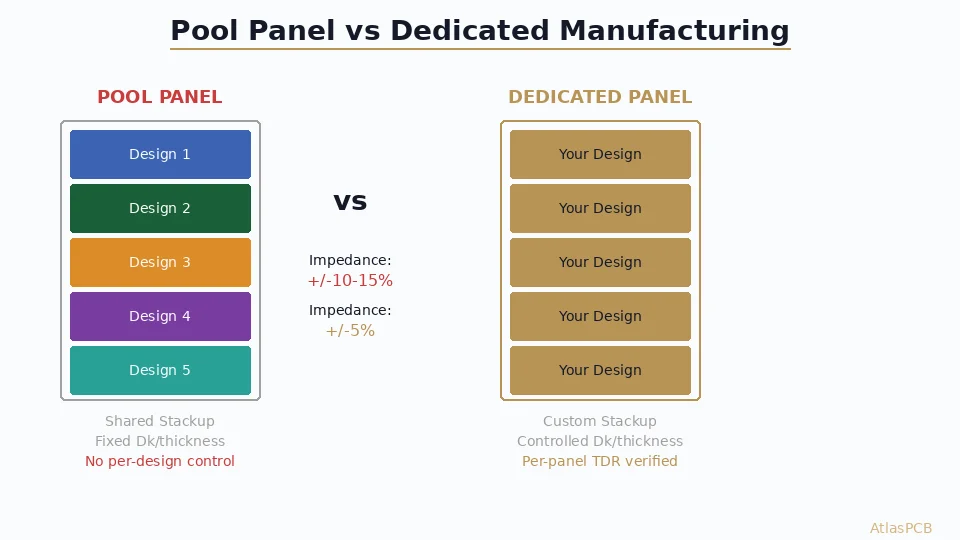
Pool panel PCB services share stackup configurations across multiple customer designs, which means you cannot control dielectric thickness, prepreg selection, or copper weight independently. For impedance-controlled designs requiring better than +/-10% tolerance, or any RF design above 1 GHz, dedicated panel manufacturing is required to guarantee consistent Dk values and trace geometry.
30-Second Decision: Pool Panel or Dedicated Manufacturing?
| Your Design | Frequency | Impedance Need | Recommendation |
|---|---|---|---|
| Digital-only, 2-4 layers | DC-500 MHz | None or +/-10% | Pool panel (JLCPCB, PCBWay) |
| Mixed-signal, 4-6 layers | DC-1 GHz | +/-10% standard | Pool panel with impedance option |
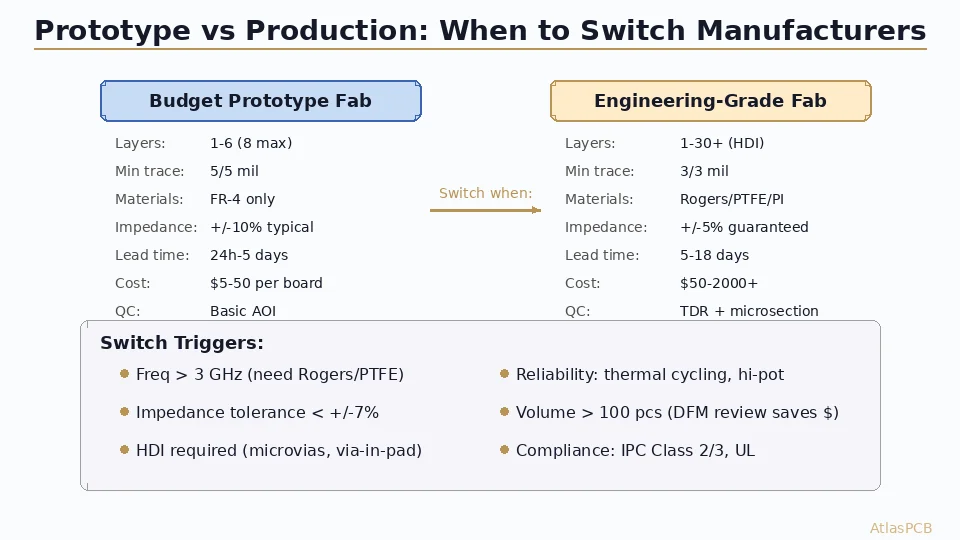
| High-speed digital, 6-12 layers | 1-5 GHz | +/-7% or tighter | Dedicated panel manufacturer |
| RF/microwave, any layer count | >1 GHz | +/-5% or tighter | Dedicated panel, material-specified |
| HDI with stacked microvias | Any | Any | Dedicated panel (pool cannot do stacked) |
| Rogers or PTFE hybrid | >2 GHz | Critical | Dedicated panel with RF experience |
The fundamental question is whether your design needs controlled manufacturing parameters or simply manufactured boards. Pool services optimize for cost and speed by standardizing everything — which works brilliantly for digital boards and fails predictably for RF and precision-impedance work.
How Pool Panel Manufacturing Works (And Where It Breaks Down)
Pool panel services aggregate multiple customer designs onto a single production panel, sharing the same stackup, materials, and process parameters across all designs on that panel. This pooling model achieves remarkable cost efficiency — a 4-layer board that costs $2-5 per piece on a dedicated panel drops to $0.50-1.50 when pooled with twenty other designs.
The economics work because the expensive parts of PCB manufacturing (artwork generation, lamination press setup, plating tank chemistry, and electrical testing programs) get amortized across many designs simultaneously. For a standard 1.6mm, 4-layer FR-4 board with 6/6 mil trace/space, there is genuinely no technical reason to pay for dedicated manufacturing. The pool panel delivers identical quality to a dedicated run.
The breakdown happens when your design needs parameters that deviate from the pool’s standard configuration. In our facility, we see roughly 30% of customers who initially tried pool services for impedance-controlled designs coming to us after their first or second order failed to meet specifications. The most common failure modes are impedance deviation beyond the pool service’s stated tolerance, inconsistent via-to-pad registration that causes stub resonances in HDI designs, and dielectric thickness variation that shifts filter center frequencies in RF circuits.
The core issue is that pool services cannot adjust press parameters, lamination pressure profiles, or plating durations for individual designs on a shared panel. Every design on that panel gets the same treatment — which means the process is optimized for the average case, not your specific requirements.
IMPEDANCE CONTROL SPECIALISTS
Need Tighter Than +/-10% Impedance Tolerance?
Our dedicated panel process delivers +/-5% impedance control with per-panel TDR verification. Upload your stackup and we will confirm achievable tolerances before production.
Upload Gerber Files ›
Impedance Control: Why Pool Panels Cannot Guarantee Tight Tolerances
Characteristic impedance on a PCB trace depends on four physical parameters: trace width, dielectric thickness (height above reference plane), dielectric constant (Dk), and copper thickness. Pool panel services control trace width through their artwork process — typically achieving +/-0.5 mil accuracy — but they cannot independently control the other three parameters for your specific design.
In a dedicated panel run, our process engineers select specific prepreg and core combinations to achieve your target dielectric thickness within +/-0.5 mil (about +/-8% on a typical 4-mil dielectric). We verify incoming material Dk with test coupons and adjust trace widths in the artwork if the measured Dk deviates from the datasheet nominal. This closed-loop approach consistently delivers impedance within +/-5% of target.
On a pool panel, the manufacturer uses whatever prepreg combination achieves their standard stackup thickness. If the prepreg flow is slightly different between batches (which it always is — even Isola specifies +/-10% resin content), the dielectric thickness shifts. A 4-mil dielectric that measures 3.7 mil due to excess resin flow will shift a 50-ohm microstrip to approximately 53 ohms — already outside +/-5% tolerance. Combined with the normal Dk variation in standard FR-4 (4.2 to 4.6 at 1 GHz depending on glass style and resin percentage), you can easily see +/-15% impedance variation on pool panels.
For digital signals at DDR4/DDR5 speeds (2400-4800 MT/s), this variation is usually acceptable because receiver equalization compensates for moderate impedance discontinuities. But for RF applications — particularly matching networks, filter circuits, and antenna feed structures — a 15% impedance mismatch creates 0.6 dB return loss degradation per discontinuity. Stack three or four such discontinuities along a feed network, and your antenna array’s beam pattern degrades measurably.
Real Numbers: Pool vs Dedicated Impedance Performance
Based on TDR measurements across 200+ panels in our facility compared to published data from major pool services:
| Parameter | Pool Panel (Typical) | Dedicated Panel (AtlasPCB) |
|---|---|---|
| Impedance tolerance | +/-10-15% actual | +/-5% guaranteed |
| Dielectric thickness control | +/-15% | +/-8% (standard) / +/-5% (RF) |
| Dk variation (lot-to-lot) | Uncontrolled | Verified per lot |
| TDR verification | Statistical sample | Per-panel (on request) |
| Copper roughness | Standard (Rz 5-8 um) | Specified (RTF/VLP available) |
| Trace width accuracy | +/-0.5 mil | +/-0.3 mil (fine-line) |
RF Design: The Hard Boundary at 1 GHz
Below approximately 500 MHz, characteristic impedance variation has minimal impact on signal quality because wavelengths are long relative to PCB feature sizes. A 50-ohm trace that actually measures 55 ohms over a 2-inch run creates a reflection coefficient of only 0.05 — essentially invisible in time-domain measurements and irrelevant to system performance.
Above 1 GHz, the calculus changes fundamentally. At 2.4 GHz (WiFi), a quarter wavelength on FR-4 is approximately 15mm — shorter than most antenna feed traces. Impedance discontinuities at this frequency create standing waves that shift the actual impedance presented to your RF IC’s output matching network. If your Smith chart work assumed 50 ohms and the trace delivers 55 ohms, your carefully optimized matching network detunes by 2-3 dB — which directly reduces TX power and RX sensitivity.
At 5.8 GHz (WiFi 6E/7, radar), a quarter wavelength drops to 7mm. At 24-28 GHz (5G mmWave, automotive radar), it is approximately 1.5mm. At these frequencies, even the via transition from a microstrip to an inner stripline creates measurable impedance discontinuity if the antipad dimensions are not precisely controlled — something impossible to specify on a pool panel.
In our production, we routinely fabricate 77 GHz automotive radar boards on Rogers RO3003 with dedicated panels, achieving insertion loss below 0.8 dB/cm and impedance control within +/-3% on 50-ohm GCPW structures. This level of control requires lamination pressure profiling specific to the Rogers material, controlled copper roughness (VLP foil), and laser-drilled microvias with precise antipad dimensions — none of which pool services can provide.
RF PCB MANUFACTURING
Building Above 1 GHz? We Speak RF.
Rogers 4350B, RO3003, PTFE hybrid stackups with verified Dk and controlled copper roughness. From 2.4 GHz WiFi to 77 GHz radar — dedicated panel manufacturing with RF-grade process control.
Cost Comparison: When Dedicated Manufacturing Actually Saves Money
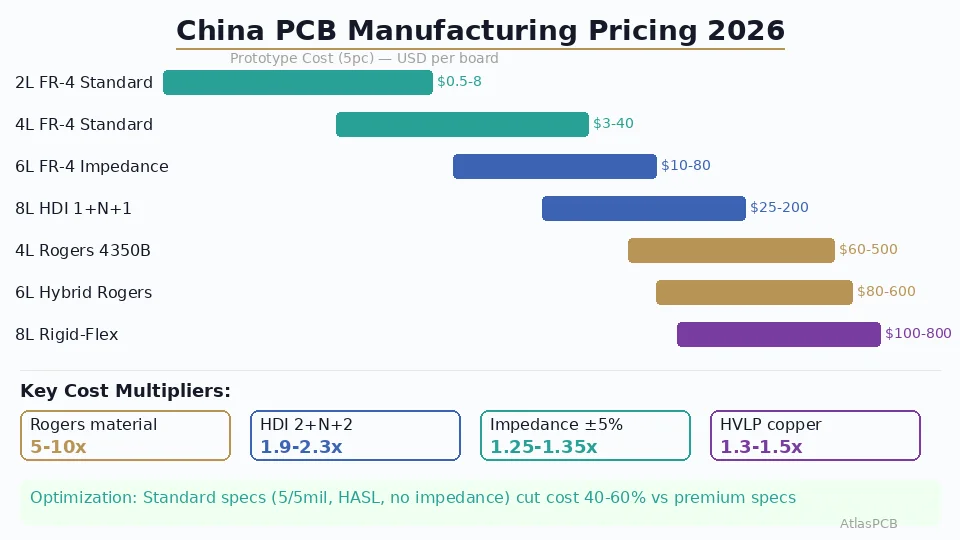
The most common misconception we encounter is that dedicated panel manufacturing always costs more. For simple digital boards, it absolutely does — 3-5x more expensive per piece in prototype quantities. But for impedance-controlled and RF designs, the total cost of ownership calculation often favors dedicated manufacturing after the first failed spin.
Consider a 6-layer impedance-controlled board with 100-ohm differential pairs for USB 3.2 or PCIe Gen 4. On a pool panel service, the board might cost $8-12 per piece in quantities of 10. On a dedicated panel, the same design costs $25-35 per piece. The pool service appears to win on cost by 3x.
But here is what happens in practice: approximately 25-30% of impedance-controlled designs that work correctly in simulation fail to meet spec on pool panels. When that happens, the engineer faces a debugging cycle — is it the design or the manufacturing? This cycle typically consumes 1-2 weeks and often results in a second order from a dedicated manufacturer anyway. The total spend becomes $80-120 for the failed pool run, plus $250-350 for the dedicated run, plus 2-3 weeks of engineering time that could have been spent on the next revision.
Break-Even Analysis
| Scenario | Pool Service | Dedicated Manufacturing | Winner |
|---|---|---|---|
| 4L digital, no impedance | $5-15 (10 pcs) | $40-60 (10 pcs) | Pool |
| 6L standard impedance +/-10% | $80-120 (10 pcs) | $150-250 (10 pcs) | Pool (if first pass works) |
| 6L tight impedance +/-5% | $80-120 + 30% respin risk | $200-300 (10 pcs) | Dedicated (TCO) |
| 8L+ HDI, stacked vias | Not available on pool | $400-800 (10 pcs) | Dedicated only |
| Rogers/FR-4 hybrid RF | Not available on pool | $300-600 (10 pcs) | Dedicated only |
The inflection point occurs when your design complexity reaches the boundary of pool service capability. At that boundary, you pay pool service prices but get unpredictable quality — the worst of both worlds.
What Pool Services Do Well (Keep Using Them For This)
Pool panel services are genuinely excellent for their target application. We recommend them to our own customers for specific use cases:
Ideal for pool panels:
- Early-stage prototyping of digital-only designs where you need boards fast and cheap
- Power supply boards with wide margins on trace routing
- LED driver boards and simple motor controllers
- Arduino/Raspberry Pi shields and breakout boards
- Any design where impedance control is irrelevant to function
- Form-factor verification (mechanical fit-checks) before committing to a controlled production run
Pool services have also improved significantly in recent years. Several now offer 4-layer boards with 5/5 mil trace/space, blind vias (1+N+1 HDI), and even basic impedance-controlled stackups at remarkable prices. For the right application, they deliver genuine value.
The key insight is recognizing when your design has crossed the complexity threshold where pooled manufacturing introduces unacceptable risk. That threshold is lower than most engineers realize — it begins the moment your design requires specific, controlled dielectric properties rather than just “FR-4 standard.”
NOT SURE WHICH PATH?
Send Us Your Stackup — We Will Tell You Honestly
If your design works on a pool panel, we will tell you. If it needs dedicated manufacturing, we will explain why and quote it. No obligation.
Upload Design ›Decision Framework: 5 Questions Before Choosing Your Manufacturer
Before placing your next PCB order, answer these five questions. If you answer “yes” to any of them, dedicated panel manufacturing is likely the right choice:
1. Does your design have controlled impedance requirements tighter than +/-10%? If your SI simulation depends on hitting 50 ohms +/-5% or your RF matching network was designed for a specific Dk value, pool panels introduce too much uncertainty. The cost of a failed first spin almost always exceeds the premium for dedicated manufacturing.
2. Are you using non-standard materials (Rogers, Megtron, PTFE, polyimide)? Pool services standardize on one or two FR-4 grades. Specialty materials require dedicated processing parameters — press temperature profiles, drill speeds, and plating chemistry adjustments that are impossible in a pooled environment.
3. Does your design require HDI features beyond basic 1+N+1? Stacked microvias, via-in-pad plated over (VIPPO), and any-layer HDI structures require sequential lamination cycles with precise registration between layers. Pool services that offer “HDI” typically mean only single-level blind vias, not true multi-level buildup.
4. Is this design going into production above 50 pieces? Once you commit to production volumes, consistency between batches becomes critical. Pool panels offer no lot-to-lot consistency guarantee — your second order might come from a completely different stackup configuration than your first, with different impedance characteristics.
5. Will a failed first prototype cost more than 2 weeks of schedule? If you are on a tight timeline where a respin means missing a deadline, trade show, or customer commitment, the risk premium of pool manufacturing exceeds its cost savings. Dedicated manufacturing with pre-production DFM review eliminates the most common failure modes before you commit to fabrication.
ATLASPCB
Ready to Move Beyond Pool Panel Limitations?
Dedicated panel manufacturing with RF-grade process control, impedance verification, and engineering support. From prototype to production — same process, same quality, every panel.
Get Instant Quote ›
Reviewed by AtlasPCB Engineering Team — 15+ years in advanced PCB fabrication for RF, HDI, and rigid-flex applications.
Related Reading:
About AtlasPCB — We specialize in complex PCB manufacturing for HDI, RF, and high-reliability applications. Explore our RF and high-frequency PCB services, impedance-controlled PCB manufacturing, or get an full PCB manufacturing capabilities . Every order includes free engineering review. Get your quote.
Reviewed by AtlasPCB Engineering Team — IPC-certified manufacturing specialists with 15+ years of production experience in HDI, RF, and high-reliability PCB fabrication. Content based on factory floor data and real customer design reviews.
Frequently Asked Questions
Can I get impedance-controlled PCBs from a pool panel service like JLCPCB?
What is the cost difference between pool and dedicated panel PCB manufacturing?
When should I switch from pool service to a custom PCB manufacturer?
Why do impedance-controlled boards fail on pool panels?
Do pool panel services offer Rogers or other RF laminates?
- JLCPCB vs custom PCB manufacturer
- impedance controlled PCB manufacturer
- PCB manufacturing
- RF PCB
- China RF PCB manufacturer