· Dr. Chen Wei · Engineering · 6 min read
Siemens Fuse EDA AI Agent
Siemens' new Fuse EDA AI Agent brings autonomous multi-tool orchestration to PCB and semiconductor design. Explore how agentic AI with RAG, NVIDIA Nemotron, and physics-aware planning automates end-to-end EDA workflows — from schematic capture to manufacturing sign-off.

Quick Answer
Siemens' Fuse EDA AI Agent is an autonomous system that uses multi-agent architecture with NVIDIA Nemotron models and retrieval-augmented generation (RAG) to plan, orchestrate, and execute complete PCB and semiconductor design workflows across multiple EDA tools — from concept verification through manufacturing sign-off — without manual step-by-step engineering intervention.
The Shift from AI Assistance to AI Autonomy in EDA
For the past five years, AI in electronic design automation has been limited to in-tool assistance: suggesting component placements, optimizing individual route segments, or flagging DRC violations. Useful, but still requiring engineers to manually orchestrate multi-step workflows between different tools.
Siemens’ announcement of the Fuse EDA AI Agent marks a fundamental transition: from AI that helps within a single tool to AI that autonomously manages entire design pipelines across multiple tools and teams.
This isn’t incremental improvement — it’s a category change. And it has profound implications for how PCBs get designed, validated, and released to manufacturing.
What Is the Fuse EDA AI Agent?
The Fuse EDA AI Agent is a domain-specific autonomous system built on several key technologies:
Multi-Agent Architecture
Rather than a single AI model trying to do everything, Fuse uses a hierarchical system:
- Supervisor agent: Decomposes complex design tasks into sub-tasks, allocates resources, monitors progress
- Worker agents: Specialized for specific domains (routing, verification, timing analysis)
- Orchestrator: Manages tool-to-tool data flow and dependency resolution
This mirrors how engineering teams actually work — a lead engineer coordinates specialists, each expert in their domain.
RAG with Physics-Aware Knowledge
The retrieval-augmented generation framework goes beyond generic LLM capabilities:
- Multimodal data processing: Understands schematics, layout images, waveform data, and text specifications simultaneously
- Domain knowledge base: Trained on EDA-specific documentation, design rules, and physics models
- Secure data governance: Enterprise-grade access control prevents sensitive IP from leaking between projects or organizations
NVIDIA Agent Toolkit Integration
Built on NVIDIA’s agent infrastructure:
- Nemotron models: Purpose-trained for engineering reasoning tasks
- AgentOps architecture: Scalable deployment across GPU clusters
- Dynamic tool orchestration: Real-time resource allocation for compute-intensive simulations
End-to-End Workflow Coverage
The agent covers the complete EDA lifecycle:
Front-End Design
- Architectural exploration and trade-off analysis
- Schematic capture assistance and netlist generation
- Testbench development for verification
- Block diagram to schematic translation
Physical Implementation
- Component placement optimization (thermal, signal integrity, manufacturing)
- Routing with multi-constraint awareness (impedance, timing, crosstalk)
- Timing closure and hold/setup margin optimization
- Power integrity analysis and decoupling strategy
Verification and Sign-Off
- Design rule checking (DRC) across all layers
- Electrical rule checking (ERC) for connectivity
- Signal integrity simulation (pre/post-layout)
- Manufacturing readiness validation (DFM/DFA)
- Gerber generation and release package preparation
The Critical Difference: Planning, Not Just Executing
Previous automation could execute individual steps when told to. The Fuse agent plans the sequence — deciding which analyses to run, when to iterate on a failing constraint, and how to prioritize conflicting requirements. It’s the difference between a robotic arm and a factory foreman.
Why This Matters for PCB Manufacturing
Manufacturing AI-Designed PCBs?
AtlasPCB's DFM review catches manufacturability issues before they reach the production floor — whether your design was human-created or AI-orchestrated.
Submit for DFM Review →Tighter Specifications, Higher Density
AI-optimized layouts tend to push closer to manufacturing limits:
- Trace/space: AI routing uses minimum clearances more aggressively than conservative human designers
- Via density: Automated placement fills available via locations for better signal return paths
- Layer utilization: Higher routing completion per layer means fewer layer count increases
- Impedance accuracy: AI can target tighter impedance windows (±5% vs. traditional ±10%)
For manufacturers, this means:
- Process capability must be documented and communicated accurately
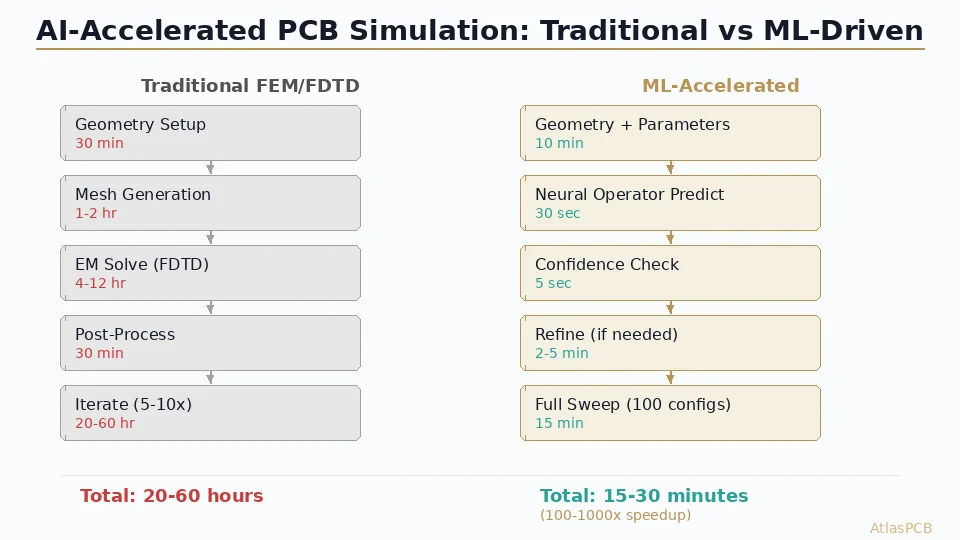
- DFM feedback loops need to be faster (AI iterates in hours, not weeks)
- First-pass yield becomes more critical as designs leave less margin
Compressed Design Cycles
When a PCB design that previously took 4 weeks compresses to 4 days through AI orchestration:
- Quote-to-production timelines shrink
- Prototype iteration speed increases dramatically
- Manufacturing partners must respond faster with quotes and DFM feedback
- Inventory and capacity planning becomes more dynamic
Data Format and Communication Changes
AI agents generate design data differently:
- Complete constraint files with every trace documented
- Automatic stackup proposals based on manufacturer capabilities
- Machine-readable DFM reports that AI can act on directly
- Potential for direct agent-to-MES communication in the future
Industry Collaboration: Samsung, NVIDIA, and Beyond
Siemens announced collaboration with major semiconductor companies:
- Samsung: Integrating Fuse into memory design workflows for cutting-edge semiconductor node development
- NVIDIA: Providing the underlying compute infrastructure and AI models
- Enterprise customers: Several undisclosed companies running pilot programs
The endorsement from Samsung is particularly significant — it validates that AI orchestration works for production-grade semiconductor and PCB system designs, not just demos.
Competitive Landscape in AI EDA (2026)
Siemens isn’t alone in this space:
| Company | Product | Approach |
|---|---|---|
| Siemens | Fuse EDA AI Agent | Multi-agent orchestration, open architecture |
| Cadence | Cerebrus AI | Intelligent optimization within Cadence suite |
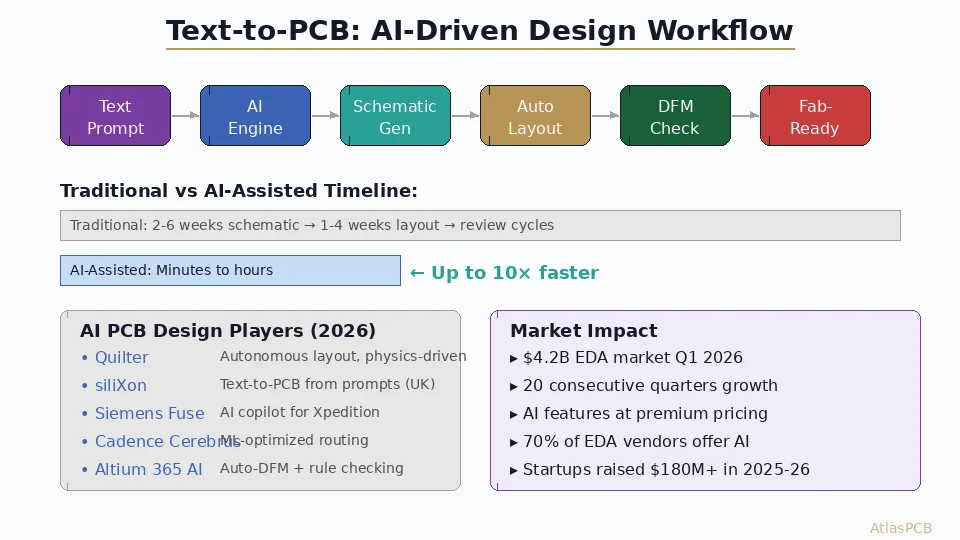
| Quilter | Autonomous Layout | Physics-first PCB auto-routing from scratch |
| Flux.ai | AI Copilot | Browser-based AI-assisted PCB design |
| Altium/Renesas | AI Features | In-tool assistance within Altium Designer |
The key differentiator for Siemens is the cross-tool orchestration — managing workflows across heterogeneous environments rather than optimizing within a single tool ecosystem.
Implications for Hardware Engineers
Skills That Become More Valuable
- System architecture — Defining what to build matters more when AI handles how to build it
- Constraint specification — Clearly articulating requirements in machine-readable formats
- Verification judgment — Knowing when AI results are trustworthy vs. need human review
- Manufacturing knowledge — Understanding what’s actually buildable at volume
Skills That Commoditize
- Routine placement and routing of standard circuits
- Manual DRC fixing of minor violations
- Repetitive schematic entry from reference designs
- Standard stackup selection for commodity boards
The “10× Engineer” Effect
Rather than replacing engineers, AI orchestration enables one experienced engineer to manage 5-10× more design projects simultaneously — setting up constraints and reviewing results rather than hand-routing every trace. This amplifies expertise rather than eliminating it.
What Comes Next
Near-Term (2026-2027)
- Wider enterprise deployment of agent-based workflows
- Integration with manufacturing execution systems (MES) for direct-to-fab handoff
- Specialized agents for domain verticals (automotive ADAS, 5G/6G infrastructure, medical)
Medium-Term (2028-2030)
- Agent-to-agent negotiation between design and manufacturing AI systems
- Continuous optimization of designs during production (digital twin feedback)
- Fully autonomous design of standard/commodity circuits from specification documents
Long-Term Questions
- How do you certify AI-designed circuits for safety-critical applications (ISO 26262, DO-254)?
- Who owns IP when AI generates novel circuit topologies?
- How do manufacturers validate designs they can’t fully trace the reasoning for?
What This Means for PCB Fabrication Partners
Manufacturers who adapt early will capture the wave:
- Publish machine-readable capabilities — Process parameters in standardized formats AI agents can consume
- Accelerate DFM turnaround — AI-designed boards arrive faster; slow quotes lose orders
- Invest in process capability — AI designs push limits; wider process windows win
- Build digital interfaces — API-based quoting and order submission for agent integration
- Document everything — Stackup options, material availability, lead times in structured data
Further Reading
- AI-Powered EDA Tools in 2026: Autonomous Agents Reshaping PCB Design
- Quilter AI Autonomous PCB Layout: From Speedrun to Production
- Siemens Xpedition Standard: AI PCB Design for SMBs
- IPC-2581 and the Smart Factory: AI Automation in PCB Manufacturing
Building boards for AI-accelerated design teams? AtlasPCB provides rapid DFM feedback, tight-tolerance manufacturing, and API-accessible quoting to keep pace with AI-driven design cycles. Get a quote or explore our capabilities.
About AtlasPCB — We specialize in complex PCB manufacturing for HDI, RF, and high-reliability applications. Explore our full PCB manufacturing capabilities, or get an instant online quote . Every order includes free engineering review. Get your quote.
Reviewed by AtlasPCB Engineering Team — IPC-certified manufacturing specialists with 15+ years of production experience in HDI, RF, and high-reliability PCB fabrication. Content based on factory floor data and real customer design reviews.
Frequently Asked Questions
What makes Siemens Fuse EDA AI Agent different from traditional EDA automation?
Does Fuse EDA AI Agent work with third-party PCB design tools?
How does AI orchestration affect PCB manufacturing requirements?
- AI PCB design
- Siemens Fuse
- EDA automation
- agentic AI
- PCB layout
- autonomous design
- machine learning