· AtlasPCB Engineering · Engineering · 8 min read
China vs US PCB Manufacturing Cost 2026: Pricing Comparison for HDI, RF, and Rigid-Flex
A transparent pricing comparison between China and US/European PCB manufacturers across standard, HDI, RF, and rigid-flex categories. Quantifies the real cost multiplier at production volumes, identifies where China wins on price, and where domestic sourcing closes the gap for advanced technology boards.
Quick Answer
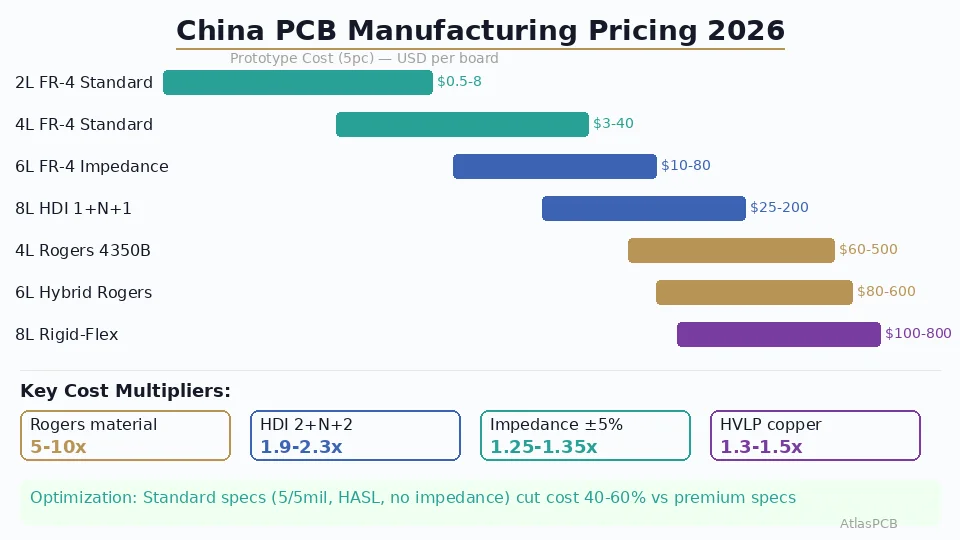
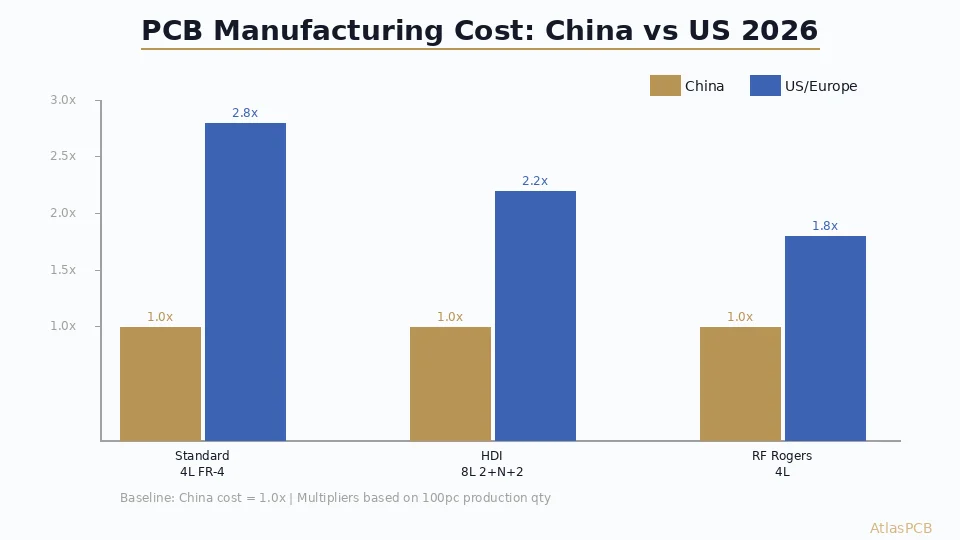
China PCB manufacturing costs 1.8-3.0x less than US/European equivalents for standard and HDI boards. The gap narrows significantly for RF (Rogers) boards (1.5-2.0x) and complex rigid-flex (1.8-2.5x) due to higher material cost percentages. At production volumes (1000+ pieces), China HDI costs $15-35/board versus $35-70/board in the US for equivalent 8-layer 2+N+2 specifications. The cost advantage is largest on labor-intensive processes (HDI sequential lamination, multilayer pressing) and smallest on material-dominated builds (full Rogers RF boards).
The Quick Comparison
| Board Type | China (100pc) | US/Europe (100pc) | Cost Ratio | China Advantage |
|---|---|---|---|---|
| Standard 4L FR-4 | $8-15/board | $22-40/board | 2.5-3.0x | Large — labor-dominated |
| 6L impedance controlled | $18-30/board | $40-65/board | 2.2-2.5x | Large — process expertise widespread |
| 8L HDI 2+N+2 | $35-60/board | $70-130/board | 2.0-2.2x | Moderate — equipment parity |
| 4L RF Rogers RO4350B | $45-80/board | $75-120/board | 1.5-1.8x | Smaller — material cost dominates |
| 6L Rigid-flex | $55-100/board | $120-220/board | 2.0-2.5x | Moderate — process complexity |
| 12L+ any-layer HDI | $80-150/board | $150-300/board | 1.8-2.0x | Moderate — few global suppliers |
Note: Pricing assumes 100-piece production quantity, IPC Class 2, standard lead time (15-18 business days China, 10-15 business days US). Prototype quantities (5-10 pieces) show smaller differentials due to fixed NRE costs.
Where China Wins: Labor-Intensive Processes
The China cost advantage is most pronounced on processes where labor, facility, and equipment utilization costs dominate over raw material costs. Standard multilayer PCB fabrication falls squarely in this category — the FR-4 laminate itself costs relatively little, and the manufacturing cost is driven by press time, drilling time, imaging, plating, and inspection labor.
For a standard 4-layer FR-4 board (1.6mm, 1oz copper, HASL, standard tolerances), the material cost is approximately 15-20% of total manufacturing cost. The remaining 80-85% is labor, equipment depreciation, utilities, and overhead. Chinese manufacturers operate with labor costs 3-5x lower than US equivalents, facility costs 2-4x lower, and equipment utilization rates of 85-95% (versus 60-75% for many US shops that handle diverse job mixes).
This economic structure explains why the cost gap on standard boards remains 2.5-3.0x despite decades of competition. A US manufacturer processing standard 4-layer boards competes primarily on lead time, proximity, and service quality rather than price. They simply cannot match China’s cost structure for commodity fabrication.
HDI boards also favor China pricing because sequential lamination is process-intensive — multiple drilling, plating, and lamination cycles multiply the labor advantage. An 8-layer 2+N+2 HDI board passes through the plating line 3 times, the laser drill 2 times, and the lamination press 3 times. Each additional processing cycle amplifies the labor cost differential. In our facility, HDI capacity runs at 90%+ utilization specifically because the process complexity that deters casual competitors creates production concentration among capable shops.
CHINA MANUFACTURING, ENGINEERING-GRADE QUALITY
HDI and RF PCB at China Pricing
Top-tier fabrication equipment, IPC Class 2/3, full impedance testing. Same quality as US shops at 40-60% lower cost.
Compare Prices ›
Where the Gap Narrows: Material-Dominated Builds
RF PCBs using Rogers, PTFE, or other specialty laminates show the smallest China-US cost differential. The reason is straightforward: Rogers Corporation sells the same material at the same price globally. A sheet of RO4350B costs roughly $80-120/m2 regardless of whether it ships to a factory in Shenzhen or San Jose.
For a 4-layer all-Rogers RF PCB, material cost represents 40-55% of total manufacturing cost (versus 15-20% for FR-4 boards). When half the board cost is identical worldwide, the manufacturing cost differential can only affect the remaining half. This compresses the China advantage from 2.5-3.0x (on FR-4) down to 1.5-1.8x (on Rogers).
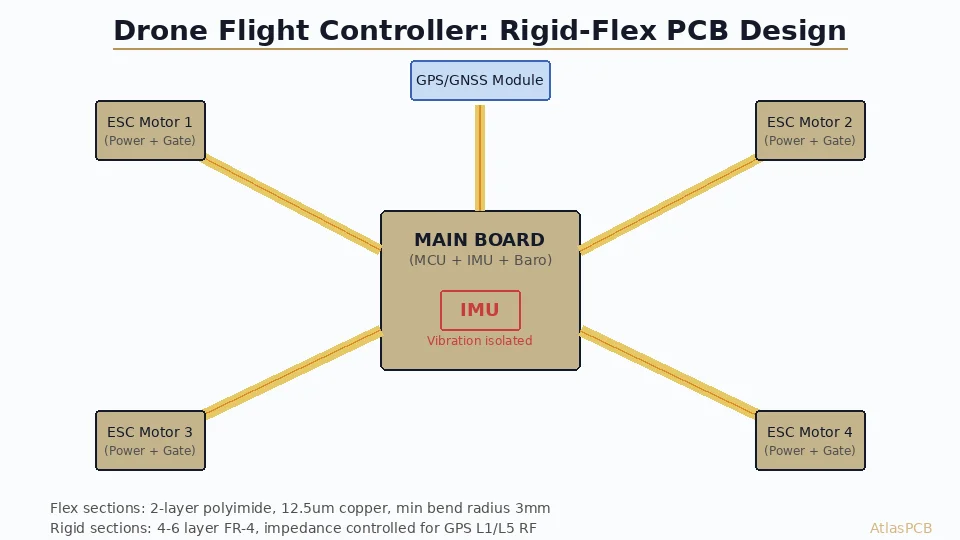
The same principle applies to specialty materials in other categories: polyimide film in rigid-flex boards, ceramic substrates, metal-core aluminum base material, and heavy copper (5oz+) applications all see narrower cost differentials because material cost percentages are high.
For buyers optimizing RF PCB cost, the hybrid stackup approach — Rogers on RF layers, FR-4 on digital layers — actually maximizes the China cost advantage. By reducing the Rogers material percentage from 100% to 30-40% of the stackup, you shift the cost structure back toward labor-dominated territory where China pricing excels. A 6-layer hybrid board with 2 Rogers layers and 4 FR-4 layers might cost 1.8-2.2x less in China versus the US, compared to 1.5x for an all-Rogers equivalent.
The Tariff Factor: How Section 301 Affects Real Landed Cost
Since 2019 (with multiple modifications through 2026), PCBs imported from China to the US face a 25% tariff under Section 301. This tariff applies to the declared customs value (typically CIF — cost, insurance, freight). For production buyers, this meaningfully erodes China’s price advantage.
Real landed cost calculation (example: 8-layer HDI, 100 pieces):
| Cost Component | China Source | US Source |
|---|---|---|
| Board price | $45/board | $95/board |
| Shipping (DHL Express) | $3/board | $0 (domestic) |
| Tariff (25% on CIF) | $12/board | $0 |
| Customs broker | $0.50/board | $0 |
| Incoming inspection | $1/board | $0 (shipped with report) |
| Total landed | $61.50/board | $95/board |
| Effective ratio | 1.0x | 1.55x |
After tariffs and logistics, the effective ratio drops from 2.1x (FOB price comparison) to 1.55x (landed cost comparison). For some buyers, a 35% savings is still compelling. For others — particularly those with small-to-medium orders where fixed costs dominate — the hassle and risk of international sourcing isn’t worth the savings.
When tariffs eliminate the China advantage entirely:
- Ultra-small orders (under 10 boards) where $50 shipping + customs minimum charges exceed the per-board savings
- Rush orders requiring air freight
- Boards requiring immediate re-spins (communication delay adds 1-2 days per iteration)
Quality Comparison: Engineering-Grade vs Budget Chinese Shops
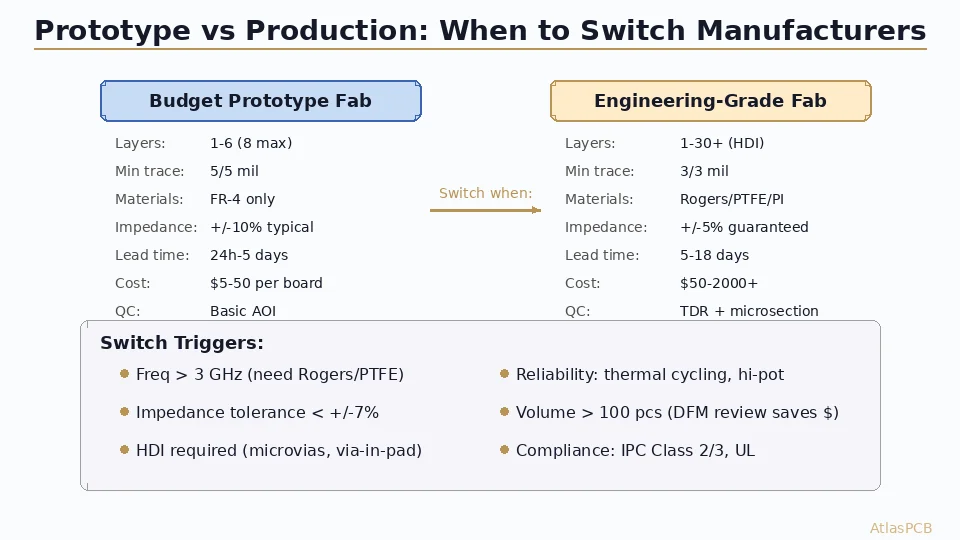
The most important distinction in China PCB manufacturing is not “China vs US” but “engineering-grade Chinese fabricator vs budget prototype house.” The variance within China is enormous — far wider than the variance among US shops, which cluster relatively closely in capability.
Budget Chinese shops (JLCPCB, PCBWay standard service, AllPCB, etc.):
- Optimized for speed and cost on standard specs
- Impedance tolerance: +/-10-15% (acceptable for many designs)
- Registration: +/-75-100um (fine for through-hole, marginal for HDI)
- Limited or no DFM review (design errors proceed to fabrication)
- No lot traceability, minimal incoming material verification
- Perfect for: prototypes, standard 2-4 layer, non-critical applications
Engineering-grade Chinese manufacturers (AtlasPCB, select factories):
- Full DFM review by experienced CAM engineers
- Impedance tolerance: +/-5% with TDR coupon verification
- Registration: +/-25um (supports 2+N+2 HDI reliably)
- Material traceability with mill certifications
- IPC-A-600 Class 2/3 inspection with report
- Suitable for: production, HDI, RF, impedance-controlled, automotive
The cost difference between budget and engineering-grade within China is approximately 30-60% — significantly less than the 2-3x gap between China and US pricing. For production-quality boards, engineering-grade Chinese manufacturing delivers the best cost-to-quality ratio available globally for most applications.
ENGINEERING-GRADE FABRICATION
Not a Budget Shop — Real Engineering Support
DFM review, impedance verification, material traceability. The quality of US fabrication at China pricing. TDR reports shipped with every impedance-controlled order.
Lead Time Comparison
| Service Level | China | US | Notes |
|---|---|---|---|
| Express prototype (2L) | 1-2 days + 3 days shipping | 1-2 days | Total: China 4-5 days, US 1-2 days |
| Standard prototype (4-6L) | 5-7 days + 3 days shipping | 5-7 days | Roughly equivalent total time |
| HDI production (8L 2+N+2) | 15-18 days + 3 days shipping | 10-15 days | China slightly slower total |
| RF Rogers (4L) | 10-12 days + 3 days shipping | 7-10 days | US slightly faster |
| Rigid-flex production | 18-25 days + 3 days shipping | 15-20 days | Similar total, China more capacity |
For production runs with planned schedules, China lead times are comparable to US after accounting for shipping. The disadvantage appears in urgent prototype iterations where 3-day international shipping adds meaningful delay to each design cycle. Engineers doing rapid hardware iteration (weekly respins) often keep a US prototype source for speed while qualifying China manufacturing for production.
Decision Framework: When to Source from China
Source from China when:
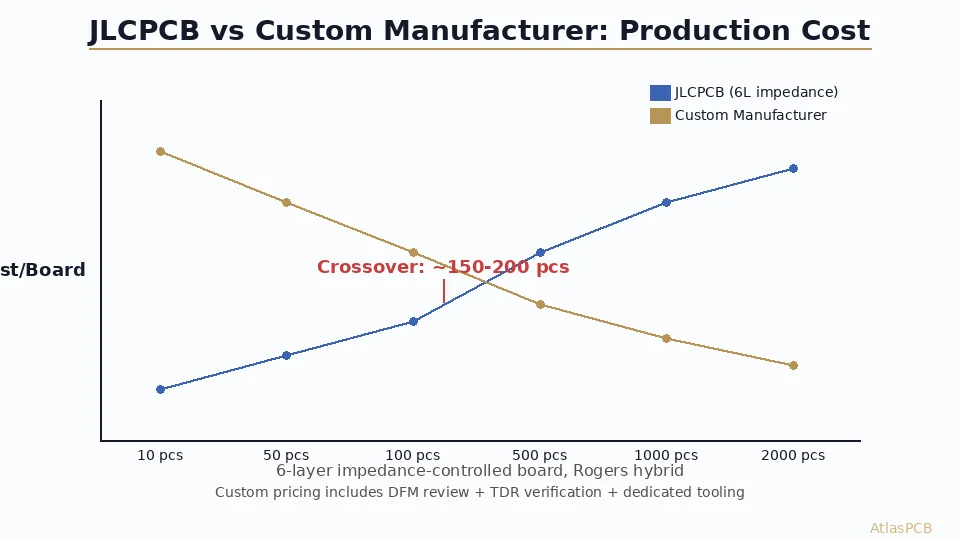
- Production volumes exceed 50 pieces (cost savings justify logistics)
- Schedule allows 15-20 day total lead time
- Board technology is HDI, multilayer, or other process-intensive construction
- Your manufacturer provides engineering DFM review (not just order processing)
- You have established quality verification processes for incoming boards
Source domestically (US/Europe) when:
- ITAR or export-controlled designs (mandatory domestic fab)
- Rapid prototype turns under 48 hours needed
- Order quantities below 10 pieces (fixed logistics costs erode savings)
- Face-to-face engineering collaboration required
- Supply chain qualification prohibits offshore (some medical/aerospace programs)
Hybrid approach (increasingly common):
- Prototype in US for speed (5-10 pieces, 2-3 day turns)
- Production in China for cost (100+ pieces, standard lead time)
- Qualification batch in China (25-50 pieces) before production commitment
ATLASPCB
Get Your China PCB Price in 2 Hours
Upload Gerber files for instant pricing. HDI, RF Rogers, rigid-flex, impedance-controlled — all quoted with DFM review included.
Upload Gerber Files ›
Reviewed by AtlasPCB Engineering Team — 15+ years in advanced PCB fabrication for RF, HDI, and rigid-flex applications.
Related Reading:
About AtlasPCB — We specialize in complex PCB manufacturing for HDI, RF, and high-reliability applications. Explore our HDI PCB manufacturing capabilities, RF and high-frequency PCB services, or get an rigid-flex PCB manufacturing . Every order includes free engineering review. Get your quote.
Reviewed by AtlasPCB Engineering Team — IPC-certified manufacturing specialists with 15+ years of production experience in HDI, RF, and high-reliability PCB fabrication. Content based on factory floor data and real customer design reviews.
Frequently Asked Questions
How much cheaper is PCB manufacturing in China vs the US?
When does US PCB manufacturing make more sense than China?
Do Chinese PCB manufacturers match US quality for HDI and RF?
What are the hidden costs of sourcing PCBs from China?
What tariffs apply to PCBs imported from China to the US in 2026?
- China RF PCB manufacturer
- HDI PCB manufacturer
- PCB manufacturing cost
- rigid-flex PCB manufacturer
- impedance controlled PCB manufacturer