· AtlasPCB Engineering · Industry News · 8 min read
PCB Material Costs Surge 70% in July 2026: How AI Server Demand Is Reshaping Supply Chains
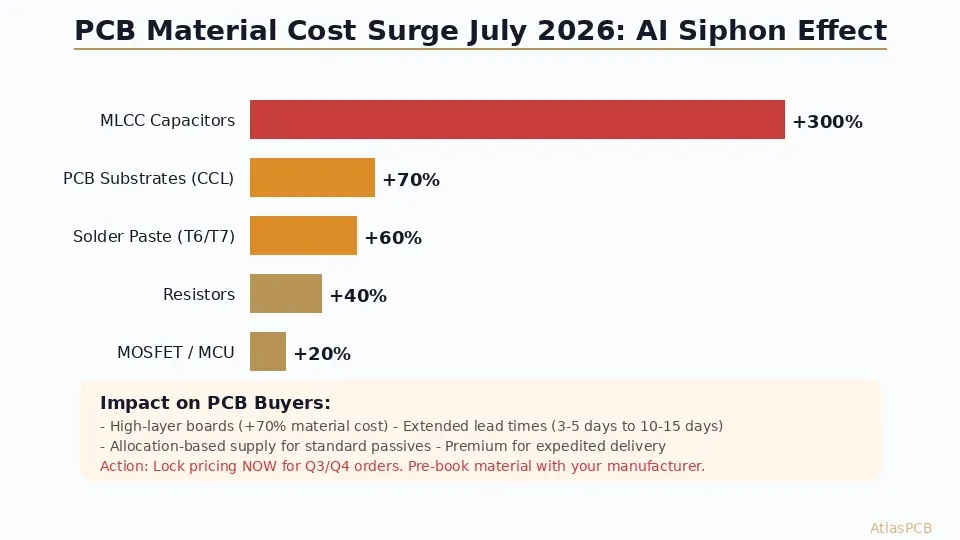
CCL up 70%, MLCC prices soaring 300%, solder paste jumping 60% — the AI infrastructure buildout is siphoning high-end PCB manufacturing capacity from every other sector. What buyers need to do right now.
Quick Answer
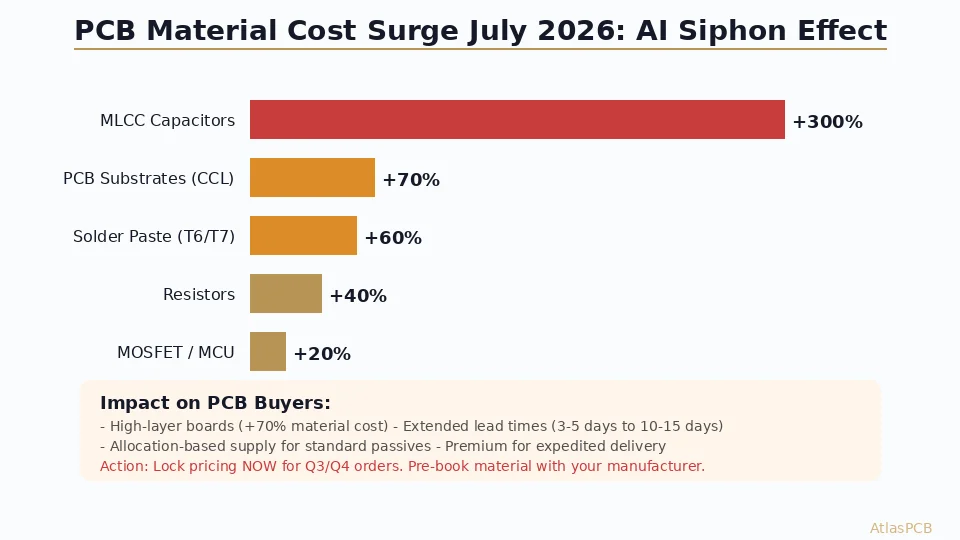
PCB material costs have surged dramatically in July 2026 — copper clad laminate up 70%, MLCC capacitors up 200-300%, and solder paste up 60% — driven by AI server demand siphoning high-end manufacturing capacity from automotive, industrial, and consumer electronics supply chains, with lead times extending from 3-5 days to 10-15 days for critical materials.
The Numbers: July 2026 Material Cost Impact
| Material Category | Price Increase (YoY) | Lead Time Change | Most Affected Specs |
|---|---|---|---|
| Copper Clad Laminate (CCL) | +70% | 3-5 days to 10-15 days | High-Tg, low-loss grades |
| MLCC Capacitors | +200-300% | 2-4 weeks to 6-8 weeks | High-frequency, high-voltage |
| Solder Paste (T6/T7) | +60% | Standard to 10-15 day allocation | Ultra-fine pitch grades |
| Resistors | +40% | Moderate extension | Precision grades |
| MOSFET / MCU | +20% | Quota-based delivery | Automotive-grade |
| Rogers / PTFE Laminates | +45-80% | 4-6 weeks to 8-12 weeks | 4350B, RT5880 |
These are not temporary spot-market fluctuations. The structural imbalance between AI infrastructure demand and available material production capacity means these elevated costs represent a new baseline for at least the next 6-9 months. Buyers planning production orders for Q3/Q4 2026 should factor a 20-30% uplift into their PCB budget forecasts versus Q1 pricing.
The AI Siphon Effect: What Is Actually Happening
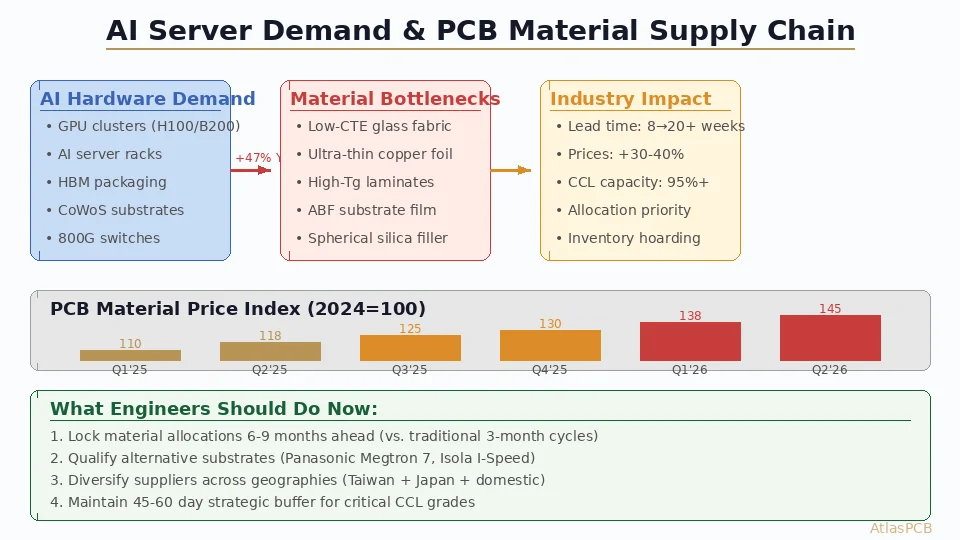
The mechanism driving this cost surge is straightforward once you understand AI server PCB requirements. A single AI training server (like those in NVIDIA GB200 NVL72 racks) uses PCB substrates that consume 10-15x more high-grade laminate than a typical consumer electronics product. These boards are 20+ layers, use ultra-low-loss laminates (Megtron 6 or 7), require ABF substrate for the advanced packaging interposer, and consume massive quantities of high-capacitance MLCCs for PDN decoupling.
When cloud hyperscalers committed to spending $800+ billion on AI infrastructure in 2026, that procurement volume locked up the production capacity of laminate manufacturers and passive component fabs. Shengyi, Nanya, and Isola have allocated significant portions of their high-grade CCL output to AI server programs with long-term contracts and premium pricing. The remaining capacity serves everyone else — automotive, industrial, medical, consumer electronics, and telecom — at whatever price the market will bear.
For PCB fabricators like us, the impact is direct: our laminate purchasing costs have increased approximately 50% since January for standard high-Tg FR-4, and Rogers 4350B lead times have extended from 4-6 weeks to 8-12 weeks. We pre-purchased significant inventory in Q1 when we saw this trend forming, which currently insulates our customers from the worst of the spot pricing. But as that inventory draws down through Q3, we will need to adjust quoting to reflect current material costs.
The glass cloth shortage deserves specific attention. PCB laminate production requires glass fiber cloth as the reinforcement in both cores and prepreg. Glass cloth manufacturers have prioritized high-spec thin cloths (1067, 1078, 1080 styles used in HDI and server PCBs) over standard thicker styles (2116, 7628 used in commercial boards). This has created a cascading shortage where even basic 4-layer FR-4 boards face material constraints because the glass cloth they need is being converted to thin-format production for AI applications.
MATERIAL AVAILABILITY
Pre-Booked Material Inventory Available
We maintain stocked laminate for common stackups. Get quoted at our locked-in pricing rather than current spot rates for standard configurations.
Check Availability ›
Impact by PCB Segment
The cost impact varies significantly depending on what type of boards you are building. Here is how different segments are affected:
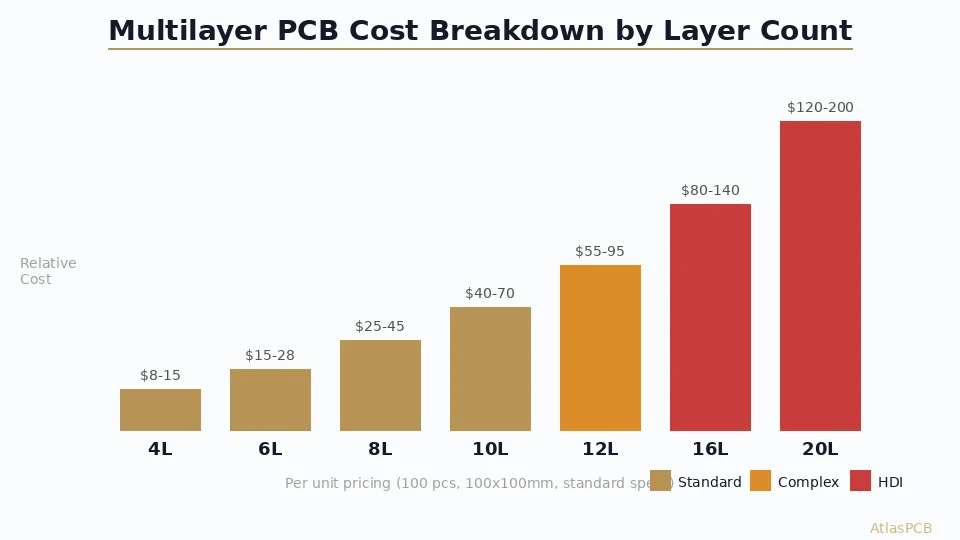
High-layer-count boards (10+ layers): Most severely impacted. These boards consume the most CCL per unit, and the high-grade laminates they require are exactly what AI servers compete for. Expect 25-40% unit price increases for 12+ layer boards compared to Q1 2026 pricing.
HDI boards: Double impact. Not only is the base laminate more expensive, but ABF film (used for microvia buildup in advanced HDI) has its own shortage driven by advanced packaging demand. HDI pricing has increased 30-50% in our facility, with further increases likely if ABF constraints worsen.
Standard 2-4 layer boards: Moderate impact in the 15-25% range. These boards use less material per unit, but they are still affected by glass cloth and basic CCL shortages. Lead times remain manageable (7-10 days) but no longer at the 3-5 day express pace that was standard pre-surge.
Rogers/PTFE RF boards: Severely impacted. Rogers Corporation has allocated capacity toward 5G infrastructure and defense programs. Commercial customers face 8-12 week lead times versus the historical 4-6 weeks. Our pre-purchased Rogers 4350B inventory (4, 6.6, 10, and 20 mil thicknesses) allows us to ship RF boards on standard timelines, but this inventory is finite.
Rigid-flex boards: Moderately impacted (20-30% increase). Polyimide film supply is less constrained than FR-4 laminate because AI servers do not use flex construction. However, the copper foil that rigid-flex boards require has increased in price due to overall copper demand.
What Buyers Should Do Right Now
Based on our conversations with laminate suppliers and component distributors, here are concrete actions for PCB buyers navigating this environment:
Lock pricing immediately for production orders. If you have designs finalized for Q3/Q4 production, get firm quotes now. Most manufacturers (including us) honor quoted pricing for 30 days. Material costs are still trending upward — a quote obtained in August may be 5-10% higher than one obtained today for the same design.
Pre-book material for repeat orders. If you run the same board monthly or quarterly, ask your manufacturer to hold laminate inventory against your purchase schedule. We offer material reservation for customers with consistent volume — you pay current pricing locked in for 90 days against confirmed purchase orders.
Reconsider material specifications. This is not the quarter to specify premium materials “just to be safe.” If your design works on standard high-Tg FR-4, do not specify low-loss laminates that are in critical shortage. Our engineering team can help evaluate whether your current material spec is truly necessary or if a lower-cost alternative maintains adequate performance margins.
Consolidate orders for volume leverage. Splitting a 1000-piece order into four 250-piece batches made sense when material was plentiful. Currently, a single 1000-piece order allows better material purchasing efficiency and often qualifies for pricing tiers that offset some of the material cost increase.
Plan for extended lead times. Standard lead times have extended 3-5 days across most complexity levels. If your project timeline assumed 5-day turns, budget for 8-10 days. Rush services remain available but at higher premiums than historical (30-50% rush fee versus the previous 15-25%).
BEAT THE PRICE SURGE
Lock In Q3 Pricing Before the Next Increase
We honor quoted pricing for 30 days. Get your production orders quoted now while material costs are still below projected Q4 levels.
Get Production Quote ›Outlook: When Does This End?
Industry analysts and our own supplier conversations point to Q2 2027 as the earliest inflection point. New CCL production capacity (primarily in Southeast Asia and China) is scheduled to come online in Q4 2026 and Q1 2027, but much of this new capacity is already pre-allocated to AI infrastructure customers through long-term supply agreements.
The realistic scenario for non-AI PCB buyers: material availability gradually improves through 2027 as capacity expansion outpaces demand growth, but pricing does not return to 2024-2025 levels. The structural shift toward AI consuming a larger share of advanced PCB materials is permanent — what we are experiencing is the acute phase of a market rebalancing that leaves everyone paying more for materials going forward.
For our customers, our strategy is transparent: we are maintaining approximately 90 days of material inventory for standard configurations, actively qualifying secondary laminate suppliers to reduce single-source risk, and passing through material cost increases at actual cost without margin padding. We believe the manufacturers who maintain material availability and honest pricing through this disruption will earn customer loyalty that outlasts the shortage.
ATLASPCB
Material In Stock. Pricing Locked.
We maintain pre-purchased laminate inventory for common stackups. Get quoted at locked-in pricing while our stock lasts.
Get Quote Now ›
Reviewed by AtlasPCB Engineering Team — 15+ years in advanced PCB fabrication for RF, HDI, and rigid-flex applications.
Related Reading:
About AtlasPCB — We specialize in complex PCB manufacturing for HDI, RF, and high-reliability applications. Explore our instant online PCB quote . Every order includes free engineering review. Get your quote.
Reviewed by AtlasPCB Engineering Team — IPC-certified manufacturing specialists with 15+ years of production experience in HDI, RF, and high-reliability PCB fabrication. Content based on factory floor data and real customer design reviews.
Frequently Asked Questions
Why are PCB material costs surging in July 2026?
How much have PCB substrate costs increased in 2026?
What should PCB buyers do about the material cost surge?
How long will the PCB material shortage last?
- pcb-pricing
- supply-chain
- manufacturing
- industry-news