· AtlasPCB Engineering · Engineering · 9 min read
JLCPCB vs Custom PCB Manufacturer for Production: Total Cost Breakdown at 100, 500, and 2000+ Pieces
A detailed cost analysis comparing JLCPCB and custom PCB manufacturers across production volumes. Reveals why per-board pricing is misleading for impedance-controlled and HDI boards, and identifies the crossover point where custom manufacturing delivers lower total cost of ownership.
Quick Answer
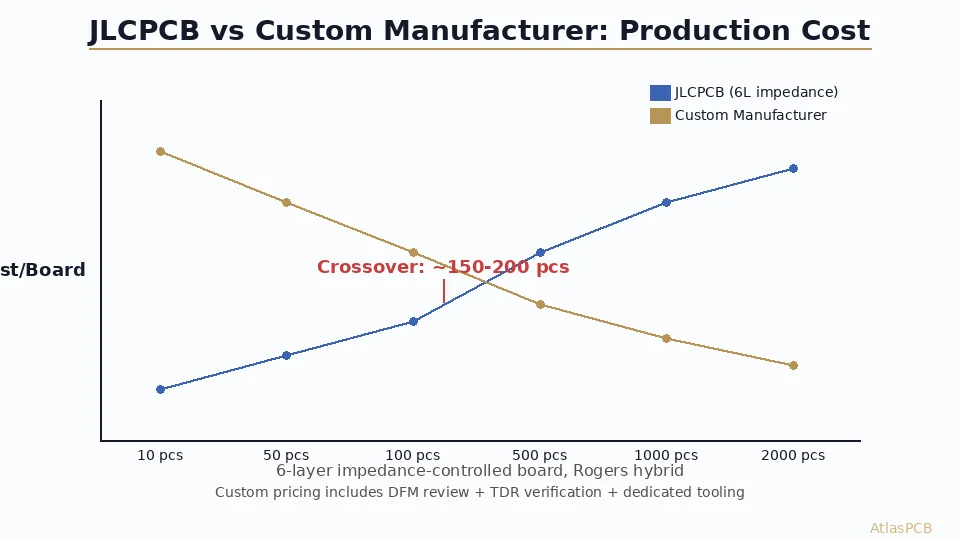
For standard 2-4 layer FR-4 boards, JLCPCB remains cheaper through all volumes. For 6+ layer impedance-controlled or HDI boards, custom manufacturers deliver lower total cost of ownership starting at 100-200 pieces when you factor in yield losses, respins, DFM review, and impedance verification that budget services charge as expensive add-ons or simply do not offer.
Quick Answer: When Does Custom Beat JLCPCB on Price?
| Board Complexity | JLCPCB Cheaper | Crossover Point | Custom Cheaper |
|---|---|---|---|
| 2L FR-4, standard | All volumes | Never | N/A |
| 4L FR-4, no impedance | Up to 2000+ | Rarely | 5000+ |
| 6L impedance +/-10% | Up to 50 pcs | 100-200 pcs | 200+ pcs |
| 6L impedance +/-5% | Up to 20 pcs | 50-100 pcs | 100+ pcs |
| HDI 1+N+1 | Up to 30 pcs | 50-100 pcs | 100+ pcs |
| HDI 2+N+2 or Rogers | Up to 10 pcs | 20-50 pcs | 50+ pcs |
The conventional wisdom that JLCPCB is always the cheapest option holds only for simple boards. The moment your design requires controlled impedance, HDI microvias, or specialty materials, their surcharge-based pricing model creates a crossover point that arrives surprisingly early in the volume curve.
The Per-Board Pricing Illusion
Most engineers compare PCB manufacturers by looking at the quoted price per board. This is the wrong metric for production decisions, and it consistently leads teams to overpay by 25-40% on complex boards at production volumes.
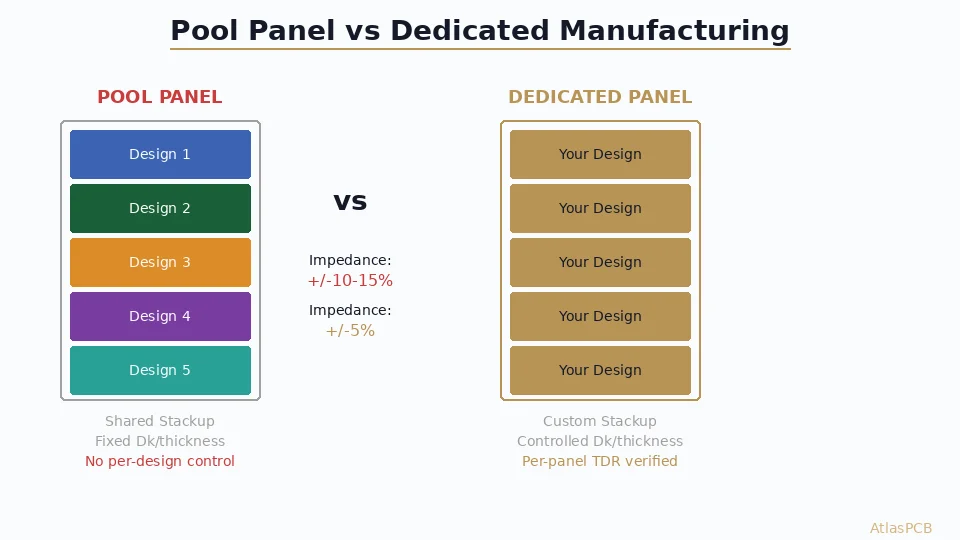
The reason is structural: JLCPCB and similar automated ordering platforms are optimized for pool panel production of standard boards. Their base pricing reflects shared panel utilization, standardized processes, and minimal engineering overhead. Every deviation from this standard — impedance control, non-standard materials, HDI features, tight tolerances — gets priced as an add-on surcharge that scales linearly with board quantity.
Custom manufacturers take the opposite approach. Their base pricing already accounts for dedicated tooling, impedance simulation, and per-panel verification as standard workflow items. The NRE (non-recurring engineering) cost gets amortized across the production quantity, making per-board cost decrease more steeply with volume than JLCPCB’s flat surcharge model.
In our facility, we track total cost of ownership (TCO) across customer orders and consistently see the crossover between budget and custom manufacturing occurring at 100-200 pieces for 6-layer impedance-controlled boards. For HDI designs with stacked microvias, it can happen as early as 30-50 pieces.
PRODUCTION PRICING
Get a Production Volume Quote with Full TCO Breakdown
Upload your Gerbers and specify quantity — we provide itemized pricing showing exactly where your cost goes.
Get Production Quote ›
Real Cost Comparison: 6-Layer Impedance Board
To make this concrete, let’s walk through actual pricing for a representative design: a 6-layer board, 100x80mm, FR-4 with controlled impedance (+/-8%), 0.2mm minimum drill, ENIG finish. This represents a typical IoT gateway or industrial controller board entering production.
At 100 pieces through JLCPCB’s advanced service, the quoted price typically breaks down as follows: base 6-layer fabrication at roughly $5.50 per board, impedance control surcharge at $2.80, ENIG surcharge at $1.20, plus express manufacturing fees if your timeline requires it. Total comes to approximately $9.50-11.00 per board before shipping. Importantly, this price includes no engineering DFM review, no individual impedance test reports, and no yield guarantee beyond basic visual inspection.
The same board quoted through a custom manufacturer with impedance specialization typically runs $12-14 per board at 100 pieces — seemingly more expensive. But this price includes dedicated panel tooling with optimized utilization (often fitting 20-30% more boards per panel than JLCPCB’s standard panelization), pre-production DFM review by a process engineer who catches issues before they become yield problems, TDR impedance measurement on every production panel with reports included, and a yield guarantee that means you receive 100 good boards regardless of manufacturing fallout.
The hidden math: if JLCPCB’s pool panel process achieves 85% impedance yield on tight-tolerance boards (a generous assumption based on the batch-to-batch dielectric variation we’ve measured), you need to order 118 pieces to reliably receive 100 good ones. That extra 18 boards at $10 each adds $180, pushing effective cost to $11.80 per good board — within striking distance of the custom quote that guarantees 100 good pieces from the start.
At 500 pieces, the math tilts decisively. JLCPCB’s linear surcharge model puts the board at roughly $8.50-9.50 each (volume discount on base, but surcharges remain constant). A custom manufacturer amortizes NRE across 500 boards, bringing per-unit cost to $7.00-8.50 with all engineering and testing included.
The Respin Tax: What Nobody Quotes
The most expensive line item in PCB production never appears on a fabrication quote: the cost of a respin. When a production run fails electrical testing or impedance verification after delivery, you’re looking at 3-5 weeks of delay, re-ordering costs, and the engineering time to diagnose whether the failure is a design issue or a manufacturing issue.
In our experience across thousands of orders, roughly 35-40% of complex boards sent to budget manufacturers without DFM review contain at least one issue that would cause yield problems in production. These range from impedance-affecting via placement near controlled-impedance traces, to acid traps in dense routing, to stackup specifications that create unachievable impedance targets with available materials.
A custom manufacturer’s DFM review catches these issues before first article, at zero additional cost to the customer. The typical DFM review finds 2-5 actionable items per complex design. Even if only one of those items would have caused a production respin, the DFM review has already paid for the entire price premium of custom manufacturing.
We track this internally and calculate that the probability-weighted cost of a respin (respin probability multiplied by respin cost) adds $3-8 per board to the effective TCO of budget manufacturing for complex designs. This single factor often eliminates the apparent price advantage entirely.
ENGINEERING REVIEW
DFM Review Before You Commit to Production
Our process engineers review your design for manufacturability issues that cause yield loss — included with every production order.
View Our Capabilities ›HDI Production: Where the Gap Widens
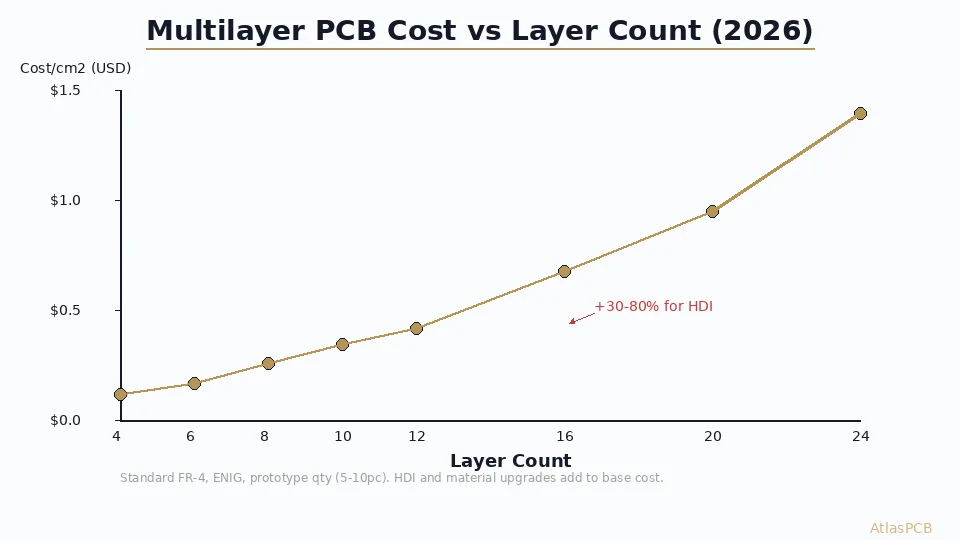
For HDI boards (1+N+1 or more complex buildup), the cost difference between automated ordering platforms and dedicated manufacturers becomes even more pronounced at production volumes. The reason is process capability: sequential lamination, laser drilling, and via fill/planarization are fundamentally different operations from standard through-hole fabrication, requiring dedicated equipment time and specialized quality controls.
JLCPCB offers 1+N+1 HDI through their standard ordering interface, but pricing at production volumes reveals the limitation of their model. A 10-layer 1+N+1 board at 500 pieces typically quotes $18-24 per board through their system, with microvia fill as an additional surcharge and no guarantee on via-in-pad planarization flatness. If you need stacked microvias (2+N+2), you’re directed to their “advanced” tier where pricing and lead times increase substantially — often to the point where dedicated HDI manufacturers undercut them while offering better specifications.
In our production data for 2+N+2 HDI boards, typical pricing for 500 pieces runs $22-30 per board depending on layer count and via density, inclusive of all sequential lamination, laser drilling, fill/planarize, and planarization inspection. The key advantage isn’t just price — it’s yield consistency. Our HDI line maintains 92-95% first-pass yield on 2+N+2 designs because our process engineers optimize the panel layout and drill recipe for each specific design rather than running it through a generic automation flow.
The production engineering support also matters at volume. When you’re building 2000+ HDI boards, even a 2% yield improvement translates to 40 additional good boards — worth $800-1200 in material and processing cost. This level of per-design optimization simply isn’t available through automated ordering systems designed for high-mix, low-volume prototyping.
The Decision Framework: JLCPCB vs Custom
The decision shouldn’t be framed as “which is better” — both serve legitimate purposes. The framework should be based on three variables: board complexity, production volume, and risk tolerance.
For prototype and evaluation builds (1-20 pieces) of any complexity, JLCPCB and similar platforms offer unbeatable convenience and speed. The risk of yield issues on small quantities is manageable because you can visually inspect every board and the cost of a few failures is negligible. This is their sweet spot, and they execute it exceptionally well.
The decision point arrives when you transition from prototype to production. If your board is standard (2-4 layer FR-4, relaxed tolerances, no impedance requirements), JLCPCB’s automated model continues to be cost-effective at any volume. Their infrastructure handles simple boards with remarkable efficiency and consistency.
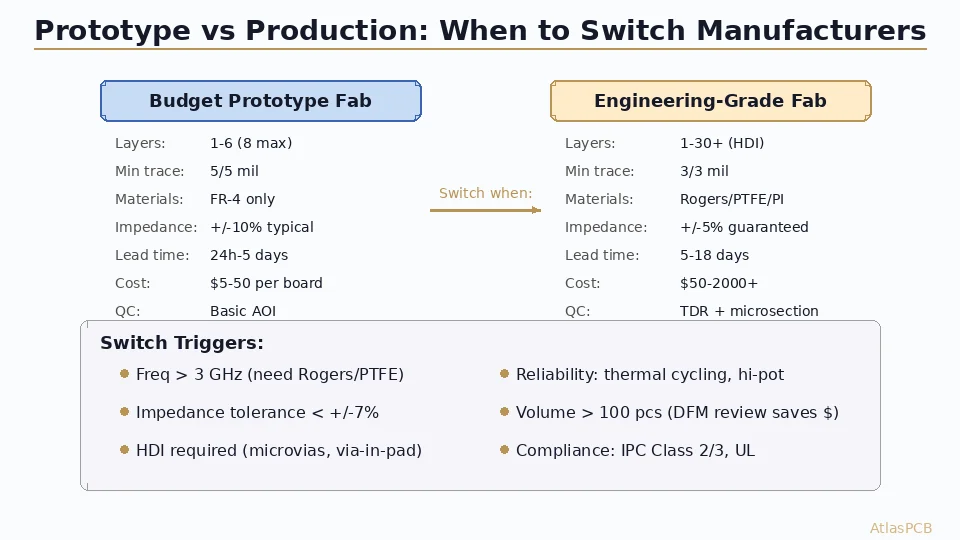
But if your design includes any of the following — controlled impedance tighter than +/-10%, HDI microvias requiring fill and planarization, Rogers or PTFE laminates in hybrid construction, backdrill requirements for signal integrity, or IPC Class 3 inspection requirements — then the crossover to custom manufacturing occurs somewhere between 50 and 200 pieces, depending on specific complexity factors.
COMPARE YOUR OPTIONS
Not Sure Which Path Fits Your Production?
Send us your Gerbers and volume target — we provide an honest comparison showing when custom manufacturing makes financial sense for your specific design.
Summary: TCO Calculation Checklist
When evaluating PCB manufacturing options for production, calculate total cost of ownership using this framework rather than comparing quoted per-board price alone:
| Cost Element | JLCPCB Model | Custom Manufacturer Model |
|---|---|---|
| Base fabrication | Low (pool panel) | Moderate (dedicated panel) |
| Impedance control | Linear surcharge | Included in base |
| DFM review | Not available | Included |
| Impedance test reports | Not available or extra | Included (every panel) |
| Yield guarantee | None specified | Contractual |
| Respin risk cost | High (no pre-review) | Low (DFM catches issues) |
| NRE amortization | Low (shared tooling) | Spread across quantity |
| Engineering support | None | Dedicated process engineer |
For complex boards at 100+ pieces, the sum of these factors consistently favors custom manufacturing by 15-30% on TCO, even when the quoted per-board price appears 10-20% higher.
ATLASPCB
Ready to Compare Production Quotes?
Upload your design files and production volume. We provide transparent, itemized quotes that show exactly what drives your cost — and where we can optimize.
Get Instant Quote ›
Reviewed by AtlasPCB Engineering Team — 15+ years in advanced PCB fabrication for RF, HDI, and rigid-flex applications.
Related Reading:
About AtlasPCB — We specialize in complex PCB manufacturing for HDI, RF, and high-reliability applications. Explore our HDI PCB manufacturing capabilities, RF and high-frequency PCB services, or get an impedance-controlled PCB manufacturing . Every order includes free engineering review. Get your quote.
Reviewed by AtlasPCB Engineering Team — IPC-certified manufacturing specialists with 15+ years of production experience in HDI, RF, and high-reliability PCB fabrication. Content based on factory floor data and real customer design reviews.
Frequently Asked Questions
At what volume does a custom PCB manufacturer become cheaper than JLCPCB?
Why does JLCPCB become expensive for impedance-controlled production runs?
What hidden costs should I consider when comparing JLCPCB quotes?
Can JLCPCB handle HDI production volumes reliably?
What does total cost of ownership include for PCB production?
- JLCPCB vs custom PCB manufacturer
- impedance controlled PCB manufacturer
- HDI PCB manufacturer
- PCB production cost
- China RF PCB manufacturer